Then shalt thou turn it into money, and bind up the money in thine hand…
Deuteronomy, Chapter 14, Verse 25
One change that I haven’t mentioned yet was the house. The house had been in the family since 1907. Or rather the family had been in the house since 1907. We only owned it outright, free-and-clear, when dad retired in the nineties. Before that we either rented or we shared ownership with the bank. The bank usually being the major partner.
Great-grampa had moved the family in. Originally from Perthshire, where he’d been a gardner at a big hoose. He must have moved to Edinburgh some time before we moved into the house — grampa and his brothers went to the Cuddy school, and he was a teenager by 1907. Great-grampa became a market gardener and grampa followed him into the business when he came back from France after the war. The house had a biggish garden, some fraction of an acre. There was room enough for three big greenhouses, a potting shed, a slag heap and loads of cold-frames. These were all still there when I was young. Grampa also hired a couple of plots of land nearby and had a couple of allotments. It must have been a fair business, he employed three or four men. This was in the days before garden centres, grampa and others like them grew the stuff you’d now buy there.
Dad had been born there, and I might as well have been — dad bought the house from grampa before I was a year old. Until I left for university I never knew another house. It was always a place full of people — the family, visiting relations, the neighbours and all the childrens’ friends. It had been like that in my dad’s time, and it was the same for Coco and I. We never locked the doors and when I brought home friends from university I didn’t bother to ask first. Room would be found.
It was where relations, parents, and grandparents and the like came when they were ill, or to die. I remember grampa Buist, granny’s dad, looking a bit like Gladstone, sitting by the open fire in the back room. He wasn’t there for long. Grampa John, mum’s dad, died in our toy room, which Coco and I had given up for him. There had been others, before our time.
Apart from a couple of years when I came back up from the north I hadn’t lived there since I was a teenager. It was still my home. In my mind I’d never moved out. The family events — Christmas, retirements, birthdays, funerals all took place there. When mum and dad had visitors from far off Coco and I were expected to make an appearance. The house was just there, we never thought about it.
After mum and dad retired mum sometimes floated the idea that they might sell-up and move somewhere more practical. Dad said nothing, but I could see by the way that he said nothing that he intended to die there. When dad died we had a problem — Coco and I were the last Andersons, we didn’t have children. Who was going to live there now?
——What are we going to do with the house? Coco asked me.
——Do you want to live here?
——No! I can’t afford it. This was a surprise to me, he’s a slum landlord, he and Ana own a couple of nice houses.
——I suppose we’d better sell it then.
And so, just like that the house, our home, became an asset, a thing.
The house was a detached cottage in Morningside. It was going to be worth a bit. I don’t know what you consider a lot of money, but when we got it valued for probate it seemed like quite a bit to me.
Like many people I lived from pay to pay. If I wasn’t on my uppers then my soles were awfy thin. It was a rare month when, by the end of it, I wasn’t pouring out the change jar and rolling-up the butts. I’ve never really minded this too much. There are problems that come with being skint, but I’m sure that there are problems that come with being rich. I have this theory (I have many theories. They’re hypothesis really as there isn’t any evidence involved) that everbody imagines that all their worries would evaporate if they just had, a wee bit more money. Sometimes they even get some, and continue to think exactly the same.
It helps that my wife and I don’t want much, we’ve never had a holiday, never mind abroad; we don’t socialize, we don’t go to restaurants and cafés; no films, no theatre; we can both cook, we’re vegetarians, we eat cheaply; neither of us drink any more; we walk everywhere, we haven’t got a car. There’s a whole lot more we don’t do, or don’t have that other people might regard as essential. They’re not essential for us.
Being perpetually skint does have it’s own unique problems. You can never quite relax, an unexpected bill can cause weeks of worry, the postman’s call doesn’t bring anything good. You have to be careful about how and where you shop; you have to keep a running total, otherwise you might get shame-faced at the till — the new self-service checkouts are great, you can sneakily pay for your purchases with handfuls of smash. Probably the worst thing about being poor is that you can feel cut of from the rest of the world. Other people do things, have things, want things that you can never have. The world is for them, the other people, you’re only looking in. It’s not that you envy other people, it’s more that you feel left out and unseen. People like us don’t feature much in the media — we only appear in documentaries, where we’re a problem of some sort.
It all sounds a wee bit miserable, and I suppose it is a bit, but most of the time I don’t think about it. Still, I’d be an odd human if there weren’t occasions when I felt that the world was being very unfair to me. But we all get down at times, don’t we? Barely a day goes by without some billionaire popping up on the telly to fulminate about the way the world treats him, (it’s always a man), and bewail his sorry lot.
Now, I was going to have a bit of money. This was very new.
religion
our space
Since we’ve been in the new building many of my suggestions for improvements have been shot down. The sixty foot high fish tank filled with Herring at the main entrance — laughed at; netting the sundeck so that we could keep a flock of Macaws — deemed impractical; the creation of an arboreal environment fit for Gibbons in the roof-space above the atrium, so that we could watch their adorable antics and catch their droppings as we lunched — dismissed with scorn. Not one to be put off, I’ve come up with a new idea — we’ll start a school religion. Well, religion is perhaps an exaggeration, allow me to elaborate…
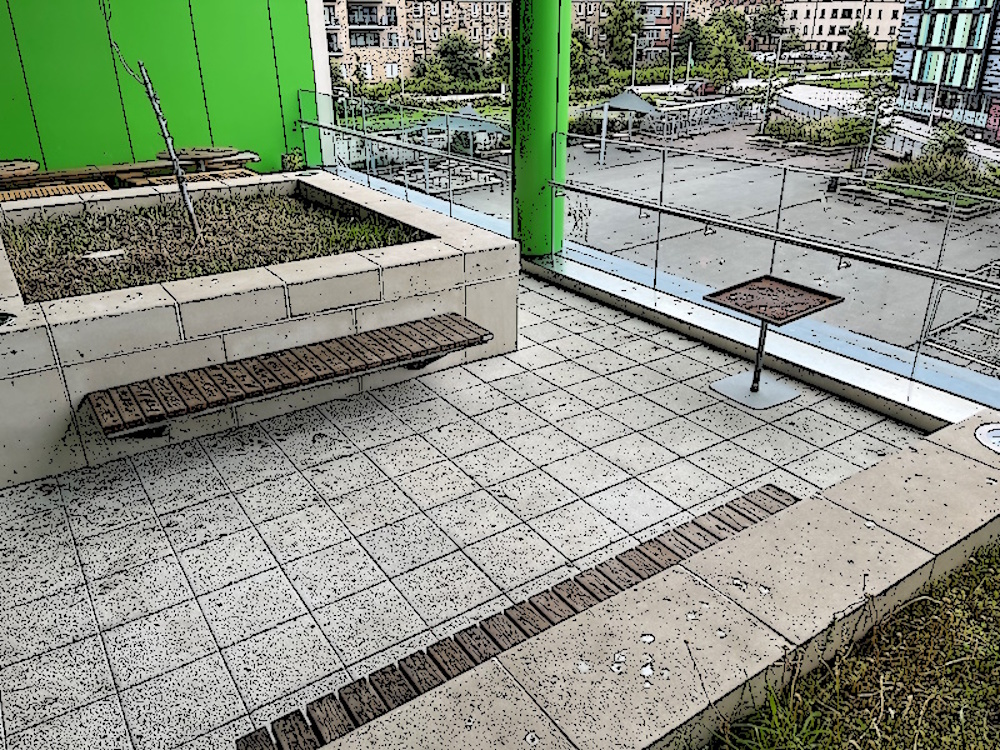
Before humanity made the egregious mistake of settling down and invented agriculture there were surely bits of the planet that meant more to them than other bits — sacred spaces. Where they met, performed rituals, feasted, gossiped and had bacchanals (although they probably wouldn’t have involved bacchus). Probably they’d mark this place with rocks covered in graffiti. Gőbekli Tepe is a good example. That’s what we need — a special space. I’ve decided that, for astronomical reasons, the solar is a good fit, it already has the special stones. If you look at the photograph above, taken around noon, on a day around midsummer, the shadow falls directly down the line of the drain (near enough). That can’t be accidental, some entity must be responsible.
We’re an educational institution so we can’t just pluck nonsense from the sky — we’ll found our sacred space on solid mathematical principles. So, let’s have a quick reminder of what spaces are in mathematical terms. Ours will be a metric, vector space so… A space is a set (which may be of anything, not just numbers) with a metric (a way of defining distance) and a vector basis (these must be linearly independent). All coming back to you now? Spaces aren’t that mysterious, we live in one — 3-D Euclidean with the normal notion of distance. [We also live in space-time which is best modelled as Minkowski space, which explains the moving fast/time slows weirdness.] The set will be of people in the school, the metric will be distance from the Solar (now with a capital letter), measured as Tula, the winner of Brufts, runs and we’ll use the same basis as a Euclidean 3-D space.
You will have noticed that nothing very mystical is going on here. That’s a feature, actual beliefs and values can be problematic for a religion, remember the story of Elijah and the Bears. Called a baldy by some children he called on the LORD to punish them, which took the form of them being eaten by some Bears. (An apologist justifies this here.) Whatever the reason for this pay-back Ursine chomping it seems a wee bit, wrong. To be sliced to sausages for calling someone a slaphead? You shouldn’t be nasty but… No, we can make up all the stories that we want but let’s steer clear of faith and judgement. So it will be a ritual space.
The ritual will be a game. I’ve acquired, what I think is, a lacrosse ball which has the right qualities of softness and lack of bounciness to fit the bill. There will be no broken windows or bouncing into the street. Over the summer the FM team and I will experiment and come up with the rules. We’ll force the young adults to play it at midsummer, midwinter and both equinoxes. For no particular reason we’ll call it the wall game. This idea is a clear winner I think.
The religion and the game, like the tank of Herring and the shitting apes, did not come to pass. Damien, one of the deputy heads, said that he’d seen something very like the tank of Herring at an expensive fee-paying school. So that was at least possible.
summer
speckled wood
The solstice has been and gone, spring’s brisk onrush has slowed to a gentle churn. Change still happens, this week pale blue Germander Speedwell has appeared, just above the water, amongst the rushes. Tufted vetch, Meadow Vetchling and Red Clover provide lumps of colour, Milk Thistles will soon prickle forth. The trees are in full leaf, their greens mellowed, less acid, less vibrant, as summer comes into its own. A sense of tranquillity has mantled my canal.
One sleepless night I gave up thrashing the duvet and set off to work about four o’clock; at least if I couldn’t sleep I’d get to see the dawn. It wasn’t the finest dawn but it was windless, the sky was a clear periwinkle blue, a pallid sun tinted the horizon with chiffon and inked the big crane against the sky. And I was alone. It was just me and the birds. Solitude has always been something I’ve enjoyed. By the time I got to the school, the hot dark torments of my night had faded away from me, lost along the path. The still air, the sweet birdsong, the tang of wet earth and damp grass, there are no hours like this at any other time of year.
Going home I was caught in a rain storm. I sheltered under the Polworth bridge, listening to cars roaring over me and watching the rain dance upon the water. I could have said that the water boiled but it didn’t look like water boiling, it was bouncing metal spouts and spreading water-rings, farther off it looked like patterned glass.
All seasons have their traumas, the things of gods and men, it’s the price we pay for living, and in some hours cheaply paid. There’s no great meaning to this planet that I can see, it’s a world well-stocked with wonders all the same.
giftee
urban starlings
The poet Burns, as Jeeves would put it, was not onto something when he wrote the following. Fine poetry it undoubtedly is, a good idea it’s undoubtedly not.
O wad some Pow'r the giftie gie us
To see oursels as ithers see us!
It wad frae mony a blunder free us,
An' foolish notion:
What airs in dress an' gait wad lea'e us,
An' ev'n devotion!
True, if we knew what people were thinking about us we’d make fewer social gaffes, people would stop dressing inappropriately, choose a gym without windows and old men wouldn’t buy sports cars. You might be tempted to wish for this if the giftee put you on the spot and wouldn’t let you use your wish for purely selfish reasons. Resist. It’s the classic sausage on your partner’s nose error. That some pompous gits would get taken down a peg or two comes at a frightful cost. Take a moment to think about some of the people you’ve met today. Is that a fond smile of blissful remembrance that is puckering your lips? It’s not is it? Would you like these people to know that you held them in such disdain? And as a person given to skulking in bushes like a geriatric Cassowary I don’t care to know what I look like to others.
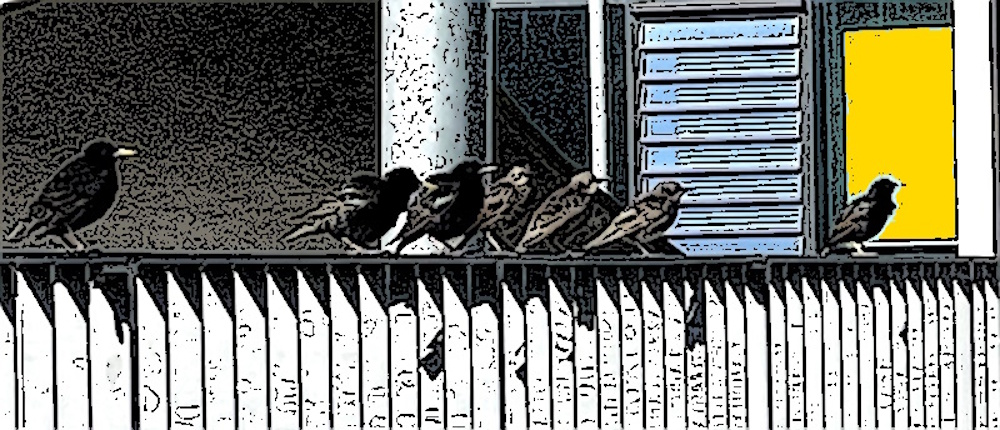
I was thinking along these lines the other morning. I was squatting, listening to the irregular clacking as the cladding on the student flats expanded in the sun, and watching the Seagull who pecks all day at that woman’s window. It was quiet, a light wind blew, the trees rustled, the grass wafted, a Blackbird was singing on the top of a lamp post. Of a sudden there was a great noise of Seagulls, they were chasing a young Buzzard back and forth low across the student flats. I had been thinking about what the playground looked like, and what other people thought of if. The Seagulls interrupted the train of my thoughts, then the day got started and soon I had other things on my mind.
I thought about it again later. Again I was squatting. This time inside one of the nettle beds, the young adults have made a path through it using one of the pallets that I left in the compost bed to rot down. In a proper garden this would be seen as vandalism, this is a playground, here it’s pretty much what we want. With the Nettles flattened I get to see what’s going on in the undergrowth — baby Sparrows looking frightened. I looked up to see a pair of Swallows hunting insects up against the east face of the school. That’s the first time I’ve seen them hunting there. A good sign I think.
I suppose that gave me my answer really. It doesn’t matter what people think of it; we made it for playing in and wildlife, the young adults are playing and the wildlife seems to be here. There wasn’t really much of a plan beyond that, and as the poet Burns warned us, plans gang aglay anyway.
term
The low early-morning sun drew sharp shapes of bright on the dark towpath. Stick figures shuttled back and forth across the Polworth bridge, some rodent, too big to be a mouse, too small to be a rat, scuttled across the path between my feet, a Seagull fledgling swam skirling circles. The warm wind smelt of earth.
The afternoon before had been dull, windless, hot and damp. The horizon jumble-stacked with bright edged clouds of gunmetal grey. The day before that was low dark skies and a fat slow rain, a day which ended with a stunning sunset of blazing carmine fire.
It’s been like that all summer, never the same weather, never the same day. I remember last summer as and endless series of the same bright day and hot night. This summer I don’t think we even managed a day without the weather changing, not even half a day. A series of vignettes.
My summer has been Seagulls cackling on a bright morning, raindrops dripping loud in the white mist, a sudden rain from a grey cotton sky, Goldfinches plucking Thistledown, basking Sticklebacks corkscrewing out of sight as a Pigeon flew over, Sparrows chattering in the Nettles, Bats darting half-seen in the eaves, a Moorhen’s long, long, yellow legs, great twisting clouds of flies under the Ivy, Snails crossing in the rain, Beetles in the dust, the wind in the Rushes, a sultry purple evening. Summer will be over soon.
lawn
the lawn
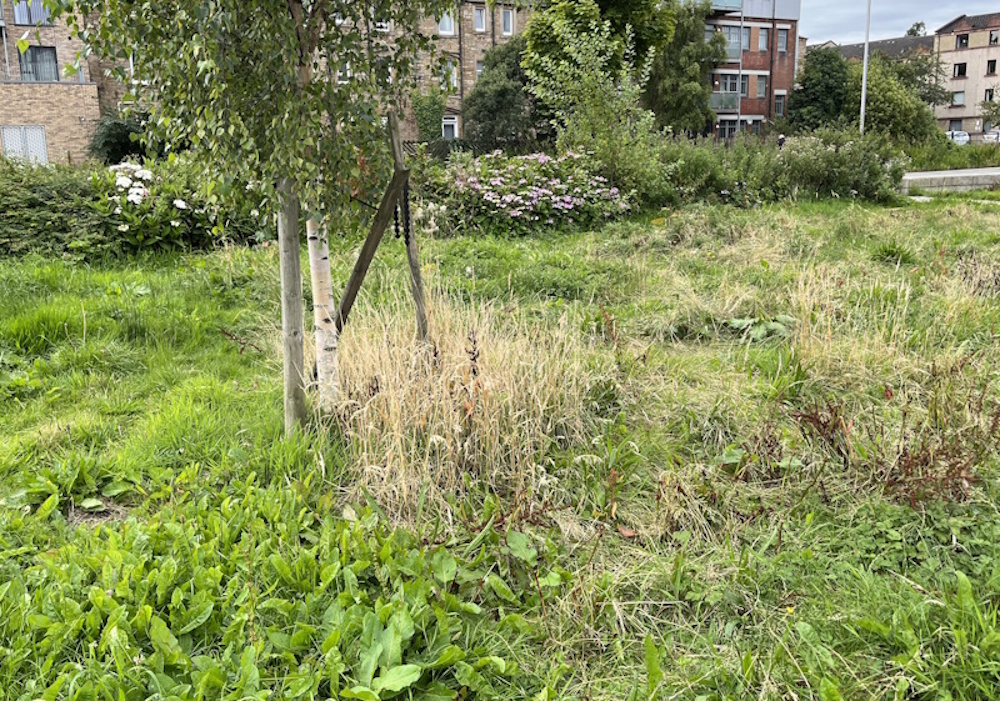
If you’re looking for a place to achieve zen mindlessness, the lawn’s a good place at the moment. That’s if you’re into one of the sitting around quiet zen schools like Shikantaza. You risk tripping up in the long grasses if you indulge in the more lively of the zen nonsenses. I say this would be a good place, I’ve really no idea what a good place to do zen should look like. Emptying my mind has never really been an option; I stay unquiet in my head. For me it’s just a good place to sit, to watch the plants and insects, to see the sky-dance of sun and cloud move across the face of the wind-grazed grass. Unlike a normal lawn you sense the pulse of life.
I walked past the old school the other day, its lawn a thing of manicured sterility, and thought how far we’ve come. When we were there it wasn’t what you’d call a lawn. More patches of grass scattered amongst a plot of ice-slick mud. A good place to fall over. We could have recreated that here simply by cutting the grass every couple of weeks.
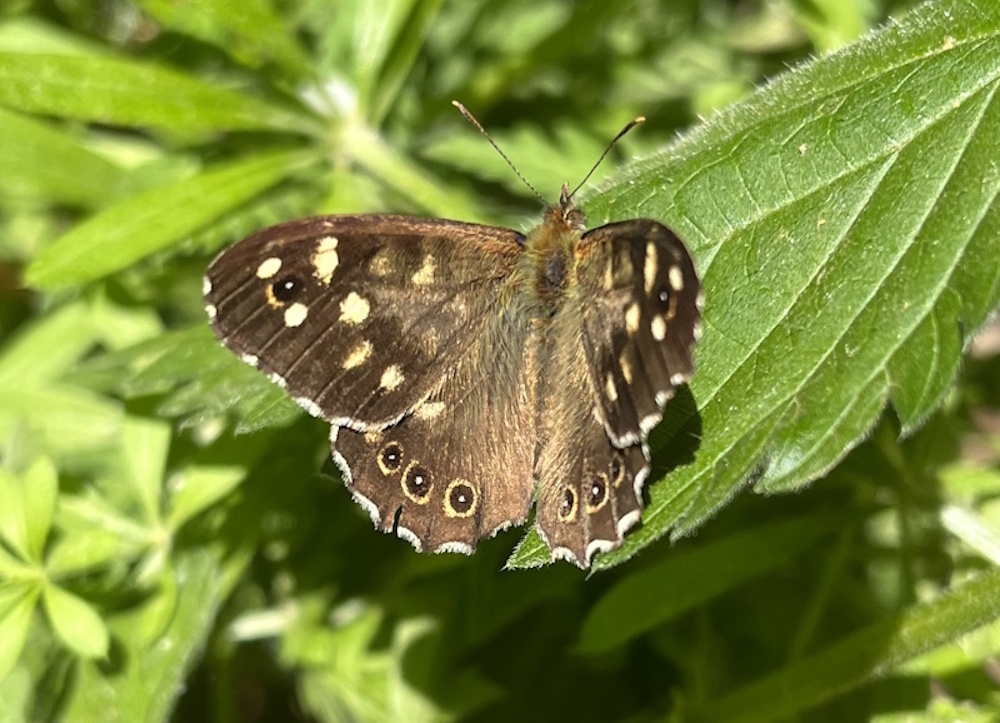
This was the first year where we took control of the grass cutting schedule, we cut about two-thirds of it at the beginning of June, and that was it. It’s been interesting to see what differences this has made. To me at least. The birds, the Pigeons, Sparrows and Jackdaws, prefer the uncut section. The Bees and the Butterflies prefer the cut section. What it has that the average lawn hasn’t is variety. And I’ll bet that, out of sight, underground, in the dark, life is busy. I think it looks lovely.
To some it may look like a mess, they are wrong. Not wrong in that it doesn’t look like a mess. But in the way that people who bang on about the importance of kids (sic) getting off their damn phones and going outside to play moan about feral youth when they see, and hear, young adults actually doing that are wrong. To be fair young adults playing does look a lot like a drunken rammy.
Soon it will get its autumn cut and that will be that. I sense however that next year there will be resistance to repeating the experiment. I’ll have to make up some bogus statistics to bolster my case. For now it remains a good place to sit and stare and think and feel.
sundeck
sundeck
The sundeck is under-utilized. That would by my opinion. Some young adults drop their lunches there and Seagulls will come if I put out leftovers scavenged from the dining hall. But that’s it. I’ve tried to tempt people out and nature in, to little effect. I suspect that the underlying problem is that it looks a wee bit blah. Some of the issues we can maybe fix, some we’ll just have to thole.
The main thing that we can’t fix are the dimensions of the space, Golden ratio it is most assuredly not. I don’t know how other humans, or animals, whose feelings we care about, in this case at least, feel, but it makes me feel slightly queasy. As if there’s a something hovering above the back of my neck. I think this is because the space too tall for its footprint? Or perhaps it’s just me being sensitive? Nothing we can do anyway.
I’m going to re-arrange the furniture, in an attempt make things seem a wee bit more inviting. I’ve also got a plan to create a teaching area. There are two problems with this plan — I have zero aptitude as a stylist of patio furnishings and even if I get it right the young adults will move things around to suit themselves. I’ll make the attempt, I don’t have too much hope.
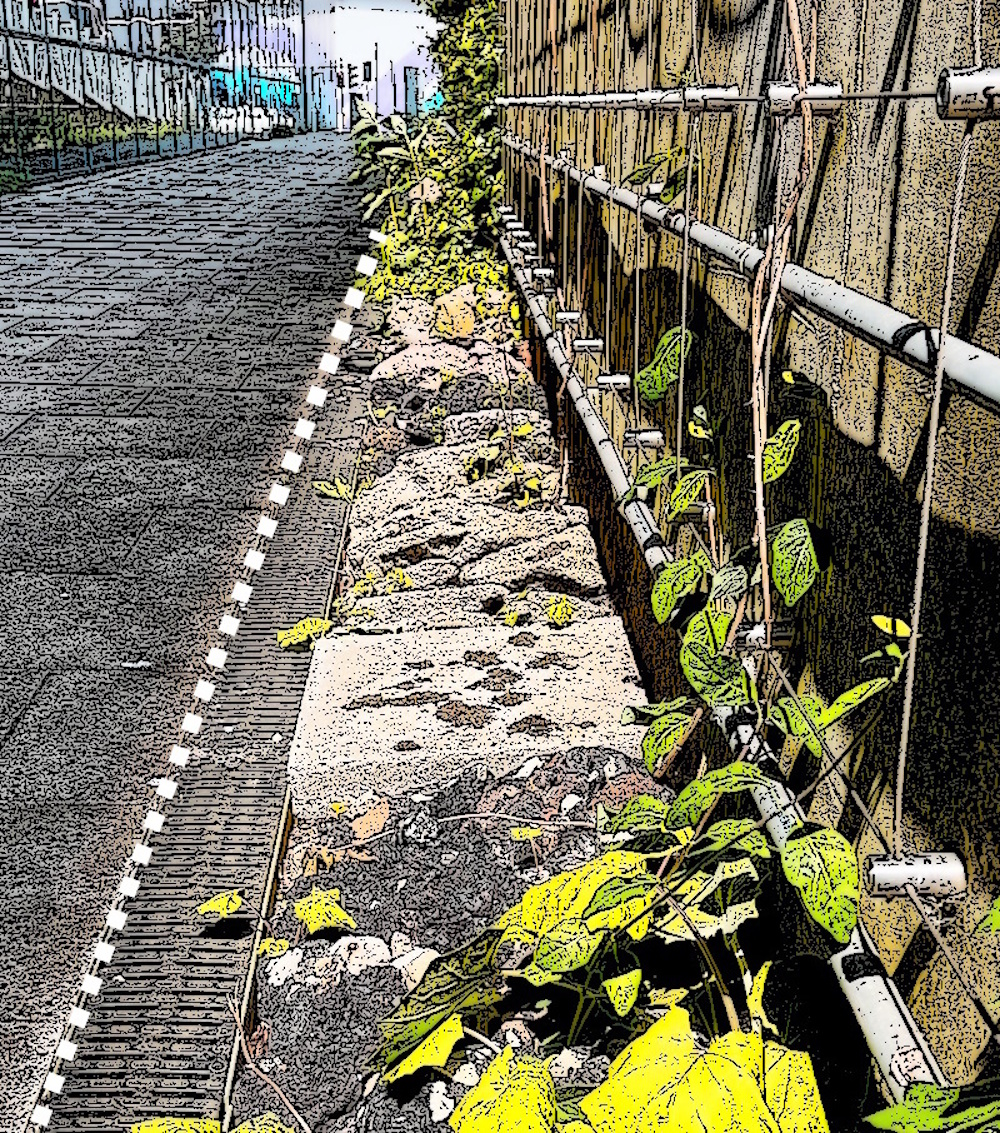
The main thing that needs to improve is the planting of the beds. These have never startled, have they? There hasn’t been an oh my gosh! moment, at best we’ve got a not too bad but …. Mistakes have been made, lessons have been learned; that’s what people say about their project failures isn’t it? We won’t say that. What we’ll say is that it’s always been a long-term undertaking, intended to come to fruition in some vague hereafter. Possibly in the never. Some progress has been made. Over the last couple of years I’ve weeded out nettles, thistles, dock and other unwanted interlopers; my sedulous hewing has rid us of the Buddleias. This year we need to tackle the grasses. Ramesh and I cut these down before they seeded (as if we were making hay) and we sowed Yellow Rattle, hopefully this will result in less silage and a better bloomage.
We do have a problem, in that what we are attempting to grow is seasonal, at best we’re only going to get a display in late summer/early autumn. We need other plants to take up some of the load, to gladden the eye and to delight the other senses. The Hostas are nice and a start, more foliage and flowers are needed.
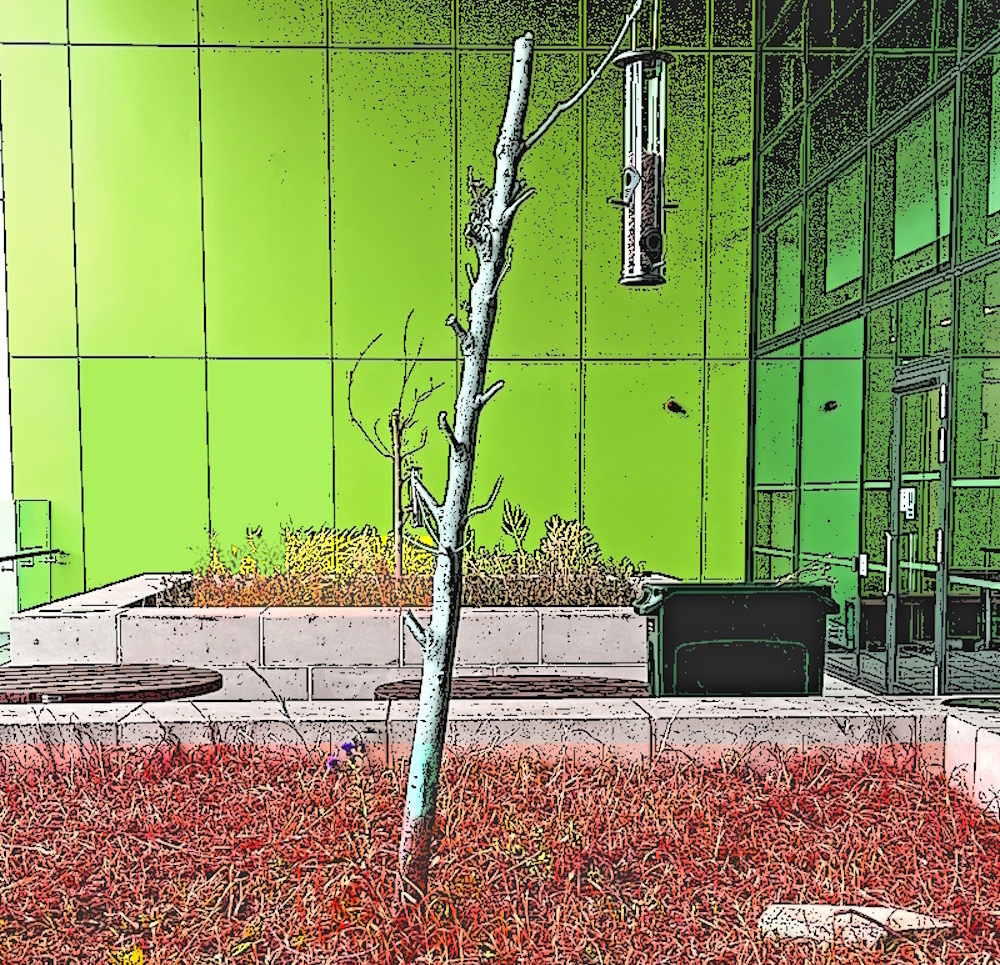
So that’s it? Well not quite, if you look at the photograph above you will notice that the trees are a wee bit … dead so to speak. The lockdown, (remember that?) and the breaking of the under-soil watering left them hanging on by their twigs. It was time to put them out their misery, chop them back, spray them silver and hang bird feeders on them. It was what they would have wanted, to serve a higher cause. If it wasn’t? Then it’s too late for them to complain now.
Maybe it’s for the best, Mr D and I, two old men who think about the future, were always worried about what would happen when the trees became huge and tall.
update
the agora
Ramesh and I spent some time re-arranging the furniture on the sundeck. Never getting a setup that we were happy with. There are two raised beds splitting the area into three parts, we decided to take all the tables and stools away from the central space. Still not happy. Then I had an idea, not about furniture diddling, but about how we would explain the arrangement.
——We’ll call it the Agora.
——Oooh kay… He sounded unconvinced.
——Do you know The school of Athens by Raphael? Philosophers lurking about on steps not unlike these? I waved my arms about.
——That’s what we’ll say. This is our Agora, where the great philosophers of the school will assemble of an evening to debate the nature of our existence.
Ramesh has been working with me for most of the summer. He has become acclimatized to my nonsense. He smiled.
I stress that I have a plan because there is a stooshie going on in the world of gardening at the moment. Apparently la Titchmarsh has written to the house of lords to complain about re-wilding. What on earth is he agitated about? And what does he want their graces to do? Make re-wilding illegal? I’m not sure what his complaint is (I don’t read the sun on principle). I think that he thinks that gardening for wildlife is a type of religious belief. And a sectarian one, one that shall allow no other gardening styles before it. Let us not forget that Alan is a tyke, and that tykes are prone to spouting the most appalling gibberish, or as they call it, speaking plain common sense. This has provoked a fierce counterblast by Isabella Tree in the grauniad. (I’m taken with her idea of replicating free-roaming beasts, the young adults could be useful there.) My guess is that the whole palaver is just the right-wing dire-rags taking advantage of Alan’s blatherings to open up another front in their war on the woke. [I’ve just found out the the failhas a woke list, they are total smegheads aren’t they?] Or perhaps the sun has a pecuniary motive, re-wilding is gardening on the cheap. Is the sun a big horticulture shill?
There is a suggestion that Alan thinks that re-wilding is just letting things grow. Not so, we have the plan:—
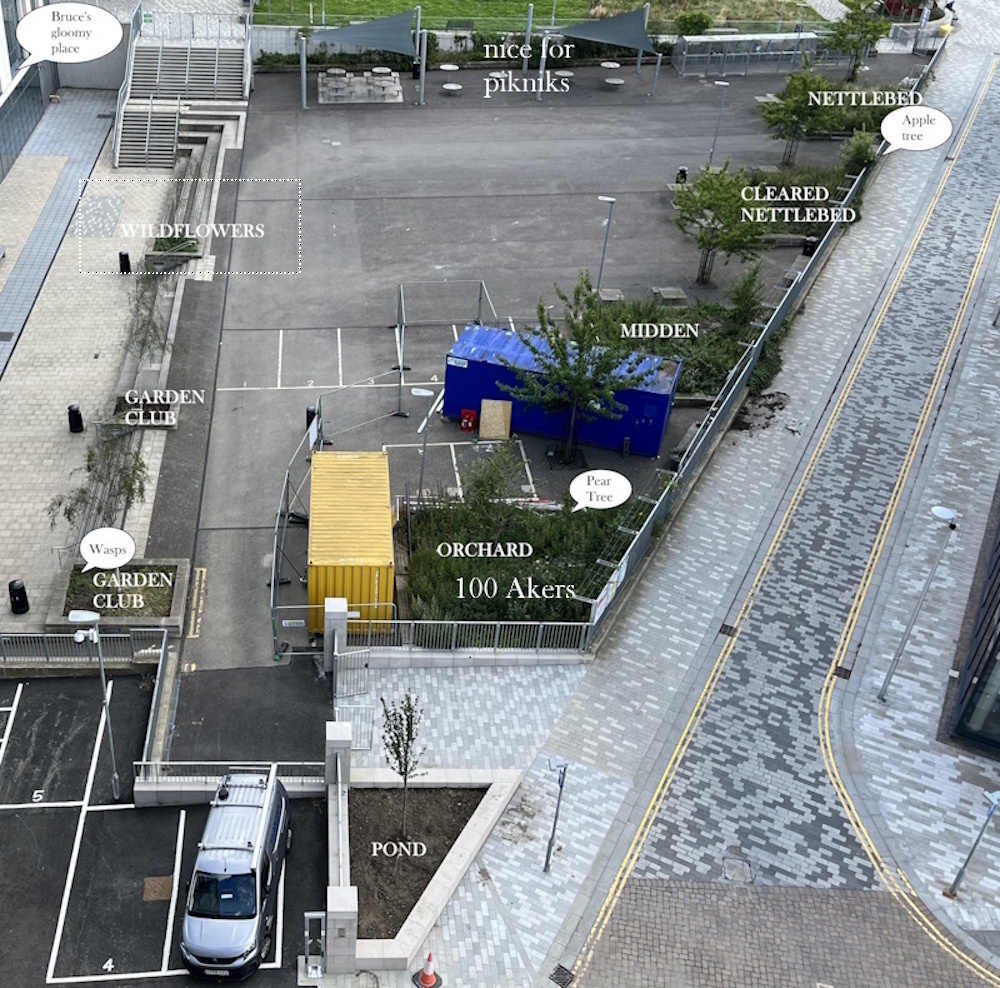
The Nettlebeds
As these have broadly similar mix of plants I’m going to try an experiment. The top bed I’m not going to touch, the other I’m going to cut back and rake off in the autumn. I cut back half of this in June which resulted in a flush of new vegetation (mostly Nettles but some Yarrow) which the insects seem to like. I counted five different types of Ladybirds the other day. It will be interesting to compare the differences between them (if any) next year.
The Midden
Another experiment. When we got this bed back from the workies I cut back the Buddleia. Since then I’ve treated is as a giant compost heap, throwing in anything organic that I’ve cleared from elsewhere. The hope is that this will become a haven for Hedgehogs and other small mammals. Rats, of course, won’t make it their home.
The Orchard
This is where we planted the pear tree. It already had a Cherry and, what I think, is an Apple tree has volunteered its services. (Another couple of Apple trees have planted themselves in the other beds.) The under-crop is mostly Thistles at the moment, which has made it exceedingly popular with the bees. These will get cut back when we get this back from the workies.
The Pond
I hope. The plan is to dig this in the next couple of weeks when the young adults return to share the blame if it all goes wrong. I’ve watched a couple of youtube how-to videos, it doesn’t look as if this should be beyond us. However I’ve a long history of over-estimating my abilities, so fingers crossed. I had been regularly hoeing this bed, to keep the weeds down until we decide what we want to grow there. I’ve now stopped, I think I see some Poppies growing, which would be nice autumn colour. The pond (should we call it the lake?) will be this year’s Hub garden group project.
Garden Club beds
Next term we are going to start a gardening club, in these two beds we’ll start our gardening journey. The young adults will decide where to go on this journey. And I will not be a Titchmarsh, they may plan whatever they like. I’ve dug over one, the other one I had to leave be because of the wasp’s nest.
Wildflowers
Last summer I sowed wildflower seed in this bed. I sowed it in the garden club beds too, but this was the only bed where they grew. I think this was because, over the winter, a group of young adults took to having their lunch there, sitting on the walls with their feet in the dirt. This looked sweet and seemed to kill the thugs who would choke the gentle wildflowers. A good example of our young adults replicating free-roaming beasts I would say. I’ll cut this back and rake it in October.
So there we have it, if Titchmarsh has the effrontery to show his face around here and starts mouthing off I’ll have something to show him before I push him into the nettles.
wasps
wasp
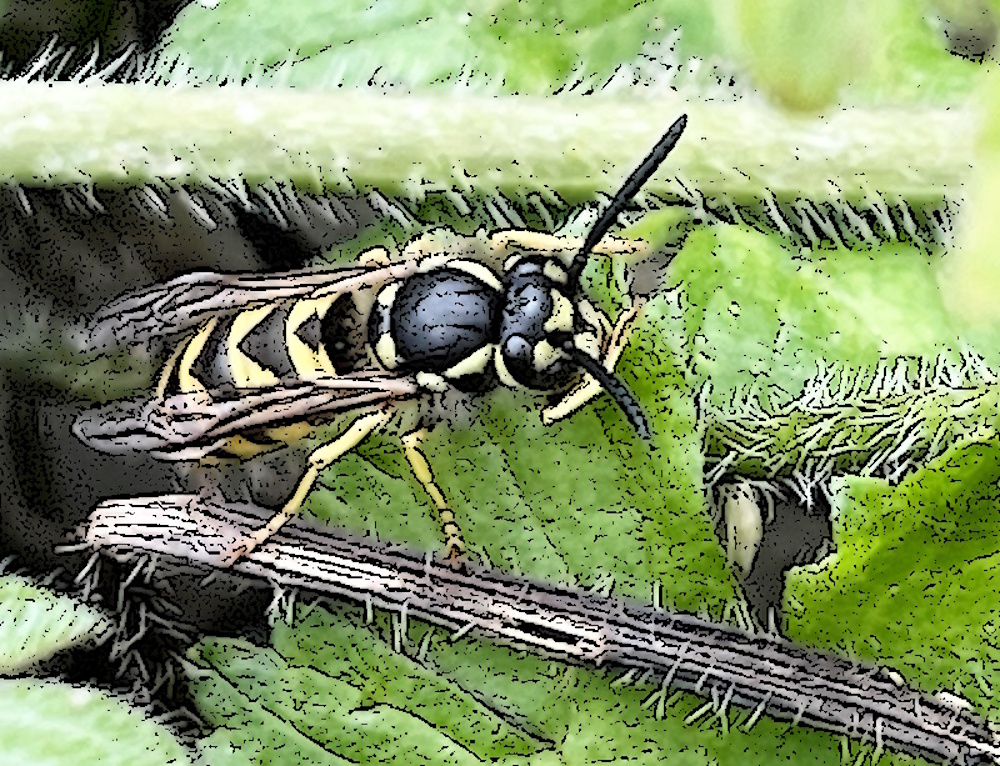
I was digging over one of the small raised beds when I became aware of the wasps boiling out from between my boots like Achilles’ Myrmidons. I slowly backed off, moving quickly and squealing, my first instinct, being unhelpful I felt. I could see about a dozen wasps, flying CAP. over the hole that I’d made. They had a, we are annoyed aura about them. They weren’t making any noise, that I could hear, and they weren’t darting hither and thither, this was business, these were wasps on the prowl for trouble. I decided to leave them to it.
I don’t know much about wasps; I was surprised that they had underground nests, so I did what any modern urban hominid would do — I went a googling. Interesting creatures wasps. I now have an explanation for something that I’d noticed, that in autumn they change what they eat. Adult wasps hunt invertebrates to feed the larvae, who, in return, feed the adults sugar. In the autumn, when there are no more larvae to raise, the adults have to feed themselves. So they don’t change what they eat, they just change where they get it.
Having allowed a couple of hours to pass I returned to the scene of the crime. The wasps had settled down, there was a steady traffic in and out the hole I’d made. They seemed calm. With my new knowledge I identified them as Vespula vulgaris — Common Wasps. I say that like this was an easy thing, it wasn’t. At first I thought that they might be Vespula germanica — German Wasps, but upon a closer observation I saw that they lacked the three dots on their Clypeus. Closer observation involved me poking around with a stick and shoving my phone camera into the faces of the wasps. They let me do this, they didn’t seem to be upset by my presence. So much for aggressive wasps I thought. Well I thought that until I got stung. To be fair this was my own fault.
I was down on my hunkers happily poking around with my stick, I may have been humming a placatory tune, I turned over a grey leaf that a wasp was sitting on. It wasn’t a leaf, underneath I caught sight of hexagonal cells and angry wasps. I felt, rather than heard, a buzzing at the collar of my tee-shirt. Then I felt the sting. I’ve been stung before, it isn’t that bad. What I didn’t want was to be stung many, many times, so another tactical withdrawal was in order.
I came back later to investigate. The Wasps had resumed their placid journeys. What must have happened was that I’d forked up a corner of the nest with my digging — the grey leaf. Why there were still Wasps in it I don’t know. I decided to postpone my excavations until autumn. I had been planning to be the wasp’s god, to make their seed as the dust of the earth, but as they have done evil in my sight they can share the fate of Perizzites, whatever that may have been. I’ll keep a careful eye on them to see if they do anything interesting.
litter
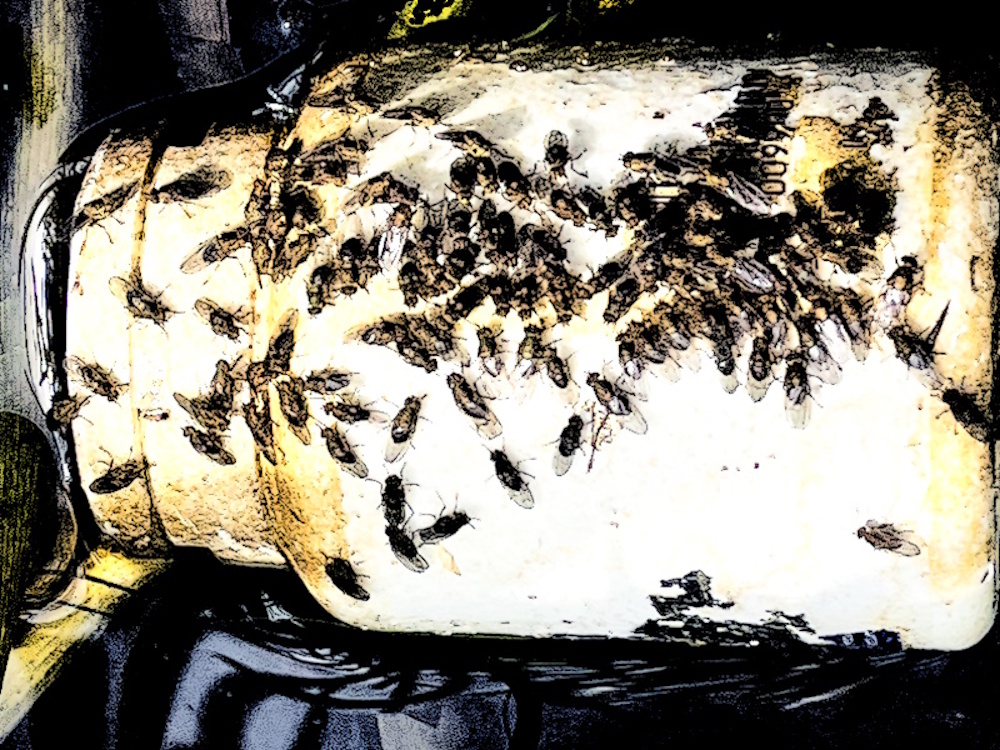
plastic with flies
For the last twenty or so years I’ve watched an old man litter picking the towpath, he doesn’t do it regularly, perhaps once a month, which makes me think that this isn’t his actual job. He’s a hobbyist. He may have some involvement with the canal, I see him talking to people, gesticulating and pointing, he has the look of someone bestowing info. Or he’s just a nut. Why does he do this cleaning? It’s not all that unusual for idle dodderers to embark upon a new career as a scaffy and it often makes the telly news. The tone of this reporting is — a laudable activity, still the codger is clearly bonkers. Why is it mad to want the world to be tidy and to try to do something about it? It’s possibly telling that it’s mainly old people who seem to feel this urge.
I’ve been thinking about litter and littering recently. More than usual that is, as a professional up-picker of others’ crap the subject is often on my mind. What set me off was an article about a study about what motivates people to litter. The results? Pretty much what I would expect — if there’s more bins and the place is already clean people litter less. There seems to be a suggestion that there’s a hard-core of unredeemable litter louts who can’t be stopped. Hmm. When I was young I followed the Hearts to Munich, I was very impressed with how clean everything was. And although the Japanese don’t even have litter bins, they keep their streets clean. So this is a cultural thing, the british are just dirty scum.
In my experience the youngest of our young adults are like bees, in the sense that they appear at primary school as fully formed litter bugs. This shouldn’t be too much of a problem you’d think — schools are in the business of moulding kids. Strangely it doesn’t seem to work in this case, by the time they get to secondary they’re worse if anything. When I pull them up for dropping stuff they have a look of puzzlement, they know that they’re in the wrong, they’ve been told often enough, but they don’t seem to grasp that they need to atone for their crime by picking their mess up. Boroughmuir is a panopticon, everybody is in sight all the time, nobody can hide, littering is not a clandestine activity here, you’re going to get caught. Now and again at least. That doesn’t seem to worry them, after lunch the dining hall (which has thirty odd bins and is clean at the start of lunch) looks like a particularly bloody battlefield of the Great War of the lunch pails. Whatever punishments we are threatening are clearly no deterrent. What should we do?
Over the years I’ve tried a few things. Once, when we were still in the old building, I tried to awake them to the consequences of their dirtiness. Mars Barr (that would be Mrs. Barr, who wasn’t called mars bar until a school newsletter relied upon spellcheck instead of a proper proof reading) ran the equivalent of the eco group then, we held, what we called Eco Lent, for which we planned a dramatic finale.
The young adults pack-lunched in the atrium in those days, an expanse of bright blue vinyl, under a high glass roof, with blue chairs stacked all about. You can imagine what it looked like when lunchtime was over, rubbish sprouting chairs by Picasso during his blue period. All week I collected nice rubbish — crisp bags and paper. On Thursday three black bags full was artfully scattered, the scene was set, I retired to the science prep room where there were windows where I could watch what occurred. The first arrivals paused at the doors (there were two), from my perch I could see their bemusement. Then a crush built up, chairs were grabbed and they started to sit round the edges, fastidiously avoiding the trash. Later arrivals followed their cue, after a quick glance at the mess, they sat round the edges too. No lessons were learnt by anybody that day.
Humanity has always been a messy species, with our middens, latrines and slag heaps. Indeed Edinburgh has particular form; Auld Reekie, where people emptied their chanties out the window with a cry of gardyloo, so that people looked up to receive a jobby in the face. This is a story that’s too gleefully repeated for my liking. It’s good to know that the town council passed the nastiness act to regulate the times you could empty your motions onto the public. What has made this a more pressing problem now is that we have created forever-filths — plastic and long lived toxins. We’re going to have to come up with a solution to that, lest the litter chokes us before global warming boils us like scouts at a jamboree. Fixing that is a little above my pay grade, where I can make a difference is in the playground.
I’ve always been a keen cleaner of playgrounds, I remember Kathy Kinsella, a janny at St. Tam’s, scolding me for my zeal, it’s not your living room Neil. Partly I spent a lot of time in the playground so I could get away from the other jannies, but mostly because the very thought of mess annoyed me. Still does. I can’t settle if I think that there’s litter scuttling about in the playground. This obsession, let’s give it a proper diagnosis, has become worse since we’ve been in the new building, here I know that I can make the place clean. Here the building works with me, the concrete, the metal, there’s a modern minimalist vibe going on. Things are bright, sharp and rectilinear, monochrome Mondrian. I say that the building shows up mess, but probably it just looks better when it’s clean. My point is that here I can make it clean and it will look clean.
So I have the bins, the clean playground and the architecture works for me, anything else? Well there’s me. It never occurs to me that other people might be taking notice of my behaviour but I expect that, like the old man we started with, I am noticed when I’m doing the playground. Which I think works in this case — people might find it harder to litter if they thought that they might get entangled with the strange old loony. I could be like the lumpy-headed caretaker character with mis-matched eyes that features in Scooby Doo plots. The odder I behave, the more unsettling I look, the less litter there will be? It’s a theory which excuses my behavior, so I think we’ll try it out.
It was now mid-August, which, for people who work in, or use, education is the real start of the year. I’d spent the summer working with Ramesh, who was filling in for Scotty, who was on one of his long-term sick breaks. Ramesh was young and keen, and didn’t like sitting around. So I felt obliged to find things for him, and I, to do. Luckily we worked well together, which isn’t always the case.
For most of my working life, I’ve done the work part alone. In a primary school you usually have to, if I was in a secondary it just worked out that way. If I was filling in for somebody I’d get the scut work, just to keep me out of the way. At Boroughmuir, if I worked with anybody it was with wee John, where we worked mostly in silence. That’s how I like it. Most janny-type work doesn’t require your complete attention — you can let your mind roam, to ponder some complete nonsense or other important stuff. Ramesh wasn’t exactly a silent worker, but at least when he talked it was about interesting stuff. He’s an interesting guy.
So we weeded and cleaned the playground, gutted the bin store, moved furniture around, re-arranged the public spaces to look how I liked them — empty and stark. We tore down all the posters and cleaned up the walls. Janitors own lots of cupboards, where they store the things they actually use and other potentially useful items. Over time these become dumping-grounds, stacked to the ceiling with disarranged heaps of mysterious things that someone had been too lazy to throw out. If you found what you needed it was only because it accidentally fell on your head. We cleaned these out, getting rid of everything useful. Finally only the plant room was left. I let Ramesh tackle this on his own.
——Ahh! So now Neil, you begin to use him. Said Ella in her hybrid Scots-Pole accent.
It was true. Once upon a time I’d have helped him. Once upon a time I’d have done it on my own.
We’d never really managed to clean up the plant room since we’d moved in. During the snagging period the workies treated it as their howf, where they dumped their crap and had their lunch. After they’d finished we tidied it up a bit. We never really gutted it, which was what it really needed, there never seemed the time. Then they started building the extension. The services — gas, water, electricity — had to be run from the plant room for this. Again it was taken from us. New crap got dumped. By the time we got it back it was an utter mess, not only was it untidy, if was full of random builder stuff. Stuff that we’d probably never use, but didn’t like to throw out, because we weren’t too sure what it was. Ramesh spent over a week in there. I think he quite enjoyed it, he certainly did a good job. It was the type of job I’d have enjoyed — throwing things out and organizing the leftovers. When I was young.
I was feeling that a lot, that I was no longer young. I suppose my failure to help Ramesh in the plant room would be a convenient peg upon which I could hang a metaphorical hat — the hat of epiphany. Where I’d realized some truth, and made a decision to make a change in my life. But humans, at least me, don’t work that way. They guddle their way towards decisions. Afterwards they might imagine, or invent, a single moment, or event, where the clouds parted and everything became clear. I’ll bet there rarely is. I suspect that Saul did quite a bit of thinking before he fell off the Donkey turned himself into Paul.
I was feeling restless. Normally I drift through life, expecting that, apart from the weather, one month will be much like the previous one, and the next month just the same. Dad’s death and mum’s re-death had unsettled me. And at the end of the summer I didn’t have my usual sense of, job done, and I didn’t feel my normal excitement for the new term. I was pleased with what we’d achieved over the summer, but without Ramesh a lot of it wouldn’t have happened. I was slowing down, worse, I was losing interest. It was becoming obvious that soon I’d no longer want to do the job properly, worse, I might not be able to. What was I going to do then? I could coast for a couple of years, I seen lots of other jannies do that, but if I didn’t do stuff, stuff wouldn’t get done. Could I put up with that?
Yeah, yeah, yeah. Let’s be honest here, all of the above is true, what made the difference was the money. The house wasn’t sold yet but it would be. Without the money I wouldn’t have had an option, I’d have moaned but I’d have managed my last few years just fine. With the money I been given a choice, so I had the luxuary of this bogus introspection. Soon I’d have enough money to retire early.