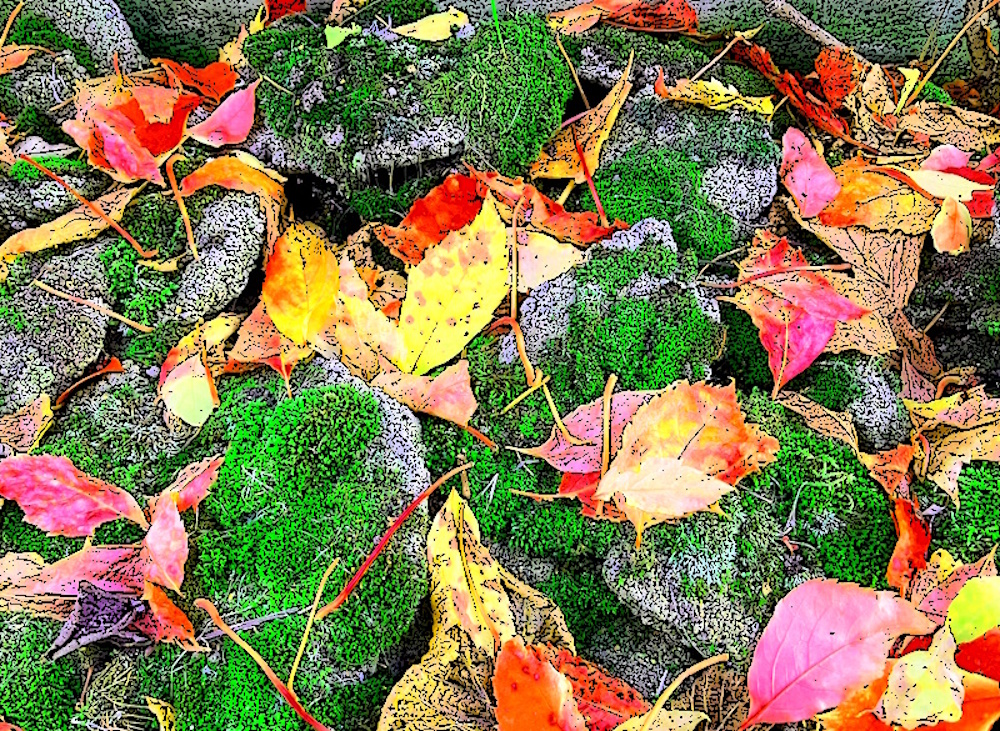
I remember thinking that, the yellow leaf stuff, lying in my bed one autumn morning. I was skiving, I should have been at school. I was in my sixth year, just seventeen, full to the gunnels with the normal teenage shit. I don’t remember what I was so miserable about, but I remember writing haiku, a very bad sign at any age, a cry for hospitalization in a teenager. I have a suspicion that much of it was down to my lack of success with girls. Maybe it wasn’t, perhaps I was annoyed at being born. Autumn, although it’s my favourite time of the year has always affected me oddly — its a time of flux, an end and a beginning, a time for reflection, a time when I think about change.
For the bulk of my life, for all of my working one, my year has been a mix of the academic and sidereal, where most of the seasons are split. Hence there are two winters. The one that starts in October, just after Halloween, where the darkness creeps down and we run up to Christmas. Then there’s the other winter, the one after new year, that starts with lean January and ends in March when we have April showers. Then after Easter summer begins. There are exams and exam leave and the world is every green. On sunny days we all go outside, teachers with their classes, everyone with their lunch. For those without exams it’s a quiet happy time. Then the long summer holidays that are always too short, with misty mornings, bright afternoons and soft dark-blue nights that are never quite get black. Autumn is different. It is short and singular. It lasts about ten weeks.
There’s always a sense of excitement to the start of the new academic year — a new start, the slate at least wiped half-clean. I remember my first week in secondary, the new timetable, all those teachers and subjects, all that changing of classrooms, starting to learn French! By the end of the week I’d been beaten up twice and if there had been any blush on the rose it was now smeared, along with my blood, across my face. That was one autumn.
Most of my autumns have been like that, a mixture, like the weather. Where there are bright windy days, puppet-theatres of shadows and light, and days of wet must, where under a gray sky I walk on slick gold. Why does autumn affect me this way? I don’t know, but it always does. I’m sad and I’m happy, I’m mournful, I’m cheerful, my mind can’t decide.
This autumn I had an actual problem — should I retire? And, if so, when?
Or did I? Have a problem, a decision to make. Looking back it seems to me that I decided to retire around now. I think I may be fooling myself, that’s not the way I usually make decisions. Normally I do things and justify them afterwards, if I need to, to myself and others, with reasons that I’ve just made up. Actually, I’ve probably made more decisions by not deciding. I’ll let the problem, or the fork in the road just quietly slip behind.
I think that I’d already decided to retire early. Now all I needed to do was to decide upon the when, and come up with a way to sell it to my wife. I’ve just placed it, all the pondering, here, in autumn, because the season suits.
When I was a child our books were different. I’m talking, mostly, about Ladybird books, which dominated my childhood reading. There must have been other books at primary school, I don’t remember those, I remember
Ladybirds in lovlinesses. Ladybirds were also the default present from The Aunts. That and the bag of liquorice pipes. Everybody at school had their version of
The Aunts
. These were whiskery wee women, powdered and floral, with corn-beef legs from sitting
too close to the fire. They came in pairs and had strange names: Bella, Ina, Meg. They lived in
houses that smelt of age and cheese. When we visited my mother held up our end of the conversation, where
tales were told of the Mays and the Bettys, the transgressions of the Jims were deplored. I was
impressed that mum could tell all these people apart. Many years later my mother admitted that she
hadn’t a clue who all these people were, or if they actually existed. I was fortunate, none of
my aunts were kissers, a common type. You often found your pals greeting in corners after a visit to
their aunts. Apparently they left a spoor on you. There were other hazards…
——she crossed her legs, ah saw her knickers!
We don’t seem to have Aunts like these any more. One theory for their existence was that they were surplus women, left spinstered by the deaths of any potential husbands in the wars. Maybe. My mother held that most of them were lesbians, using the fortunate lack of batchelors as cloak for their sin.
I remember Ladybirds fondly, the pictures especially. A particular favourite was
What to Look for
in Autumn
illustrated by Charles Tunnicliffe, it had very good pictures.
And every year, when I sense summer failing, I’m tempted to buy a copy online. That’s
against my rules for the books that I love; I have to find these in second-hand bookshops. One day
perhaps. You’ll sense where I’m going with this I’m sure — I feel autumn is
coming.
I notice the arrival of autumn suddenly, I’ll be struck by something in the sky. A type of
rain, a chilly morning, clouds scudding in a wind, the lowering sun, the moon’s huge pink
crescent rising in a lapis lazuli dusk. I get a feeling, one peculiar to this season, a poignant
joy, complex and fierce. Once I’ve had it I start to notice signs of autumn everywhere. The
plants along the towpath are nearly spent; Thistle down floats in the wind, the Wild Oats are ripe,
the winds batter down the Willow Herbs, everywhere there are bronze spikes of Dock. Only the
Michaelmas Daisys’ time is here. Soon there will be big moons and big Spiders, then the leaves
will fall, the days will shorten, the world will grow stark.
We work in education, August is the real start of our year, a time to start again. But it’s a
season of death too, of completion and the passing of things. Soon much, like the Aunts, will be no
more. That’s not a bad thing, nothing should last forever, and who thinks of these things in the wide
pink dawn?
brambles
ripening brambles
I spent the second summer of the miners’ strike hitching around England, going no-place really,
meeting people, visiting friends, talking politics. I remember it as a hot dry summer, one of long
grey roads between oddly-named places, under other peoples’ skies. The motorways were full of
transients like me, young, unemployed, bored and rootless. It was a time of limbo, of pending
change; soon the miners would trickle back in anger and there would be
no
such thing as society
anymore. That summer is vivid to me still, it was bounded with two
long walks.
The first was through a night-time London. I was going to a party at a squat in Stoke Newington. I
got dropped off just south of Watford around midnight, the tube was closed, I decided to walk. There
were no buses but there were maps on every bus stop, so if I followed bus routes I’d have a
long walk but I wouldn’t get lost. I journeyed through streets with names from legend:
Edgware, Hamstead, Kilburn, I came to Marble Arch with the dawn. I walked an empty Oxford Street,
turned north at Spitalfields Market and took the Kingsland high road to my destination. To celebrate
I bought a bacon roll for breakfast in a café full of rastas playing dominos and listening to
dub.
The second was one late-autumn evening. I was heading back to Edinburgh, I’d come from
Falmouth, it had been a two day hike. I got dropped at the north end of Biggar (London’s big
but Biggar’s Biggar). This road I knew well, I’d been shuttling back and forth
along it all summer — north to collect my giro, then off back south again. Traffic was almost
non-existent so I walked. I daunered along in the gloaming, through tunnels of black Pine, picking
the Brambles that filled the hedgerows as I went. I got a hitch at Nine Mile Burn, saw Edinburgh’s lights as we rounded the
Pentlands and passed the clock at Morningside Station in the dark.
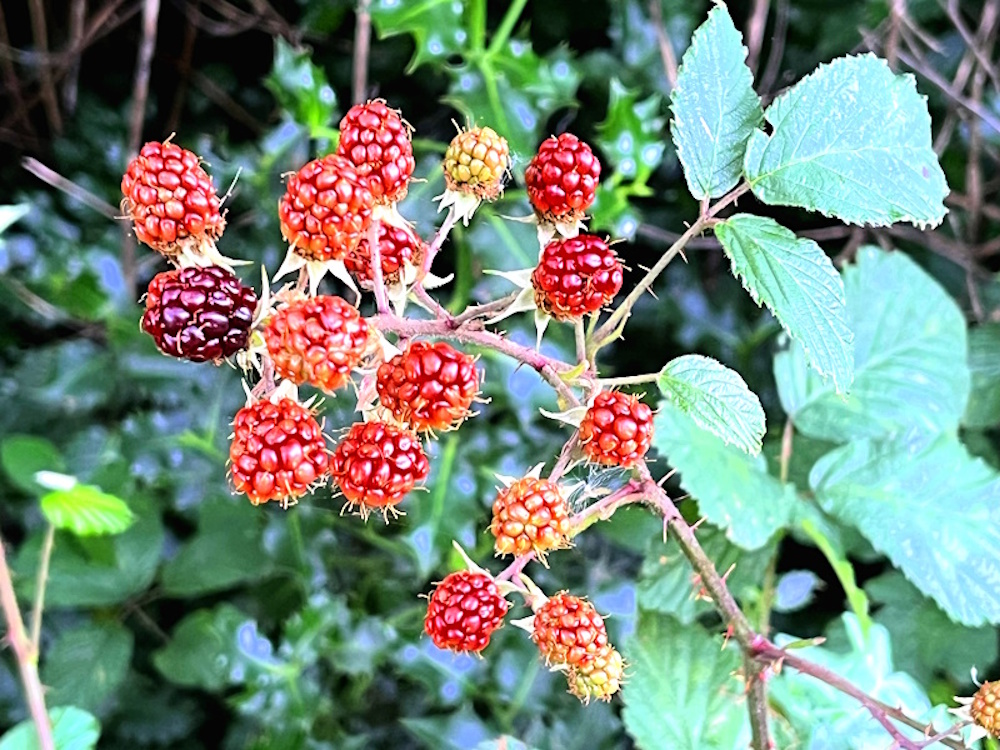
At this time of year, when summer fades and the Brambles ripen I sometimes think of those days.
Brambles are a shrub of the margins par excellence, if they aren’t on an edge
they’ll make one to creep over. Back then, to me, they were just the fruit, providential
forage on a ramble. Now they’re with me all year round. Their savage-clawed canes crawl forth
in spring to bear discordantly dainty flowers whose petals curl and drop to expose the swelling
fruits; first green, then white, then hard inflamed red bobbins which soften and blacken in the
weakening sun, to be eaten by some creature, or to fall and stain the towpath black with their
blood. In winter they lie low, hidden beneath the brown leaves, waiting patiently for a new sun to
arise. But this is still their season for me, when I think of them the most.
At this liminal time, on the cusp between summer and autumn, this illusive lull between the margins,
I often assess my life and the choices that I’ve made. That autumn I made a big
decision, I could have gone to London, where there were jobs and people who knew me. I chose to stay
unemployed in Edinburgh. Perhaps it was the slightly sour taste of the Brambles on that balmy
evening that tipped me over, and made me finally realize that I had really come home. Doubt
it, I’m probably just lazy.
minilivestock
hover fly
If this place were a farm it would be harvest time. Maybe. I think. Let’s be honest, most of us
know duff all about farming, we have no idea of the stations of agriculture, of what is due when.
There may be a time to sow, a time to reap, but when are these times? Food-wise we’re not
connected to the seasons any more, we have Strawberries all year round. About the only food that I
notice as seasonal are potatoes. I’m always pleased to see the arrival of Jersey Royals in
spring and at this time of year my favourite Ayrshires. This summer I’ve filled my daily bowl
with Anyas, a propriety frankenstein potato, tasty all
the same. When it comes to root vegetables our principles must take a back seat. Anyway, let’s
assume that it is harvest time — how have our crops done?
Vegetation wise our crops would be mostly weeds, but we knew that was going to be the case. I like
the weeds, they have character, they add a pleasing hint of wildness that goes well against the
concrete. One might be tempted to say that it was a metaphor for what we do here — develop the
potential of our young adults within a supportive framework. Of course that would be hippy nonsense.
We aren’t arable farmers anyway, our business is in livestock — minilivestock, the
littlest of our fellow creatures,
Rabbit’s
friends and relations
. The bugs.
How are our invertebrates doing? I think very well, but is my, subjective and biased,
judgement to be trusted? Well, short of proper sampling, which I’m sure that none of us can be
bothered with, what else have we to rely on? No, we’re stuck with my imprecise guesstimate.
I’m not going to put any figures on it, that would be taking the piss, but I’d have said
that they’ve doubled since last year, if doubled wasn’t a number. I’ve seen four
species of Butterfly; dozens of different Ladybirds, Bees galore, I’ve been stung by Wasps,
there are Moths and Spiders and Flies and Beetles and… You get the picture. If you look
you’ll find.
The hedgerow (née border) by the meadow (the ci-devant lawn) has been particularly
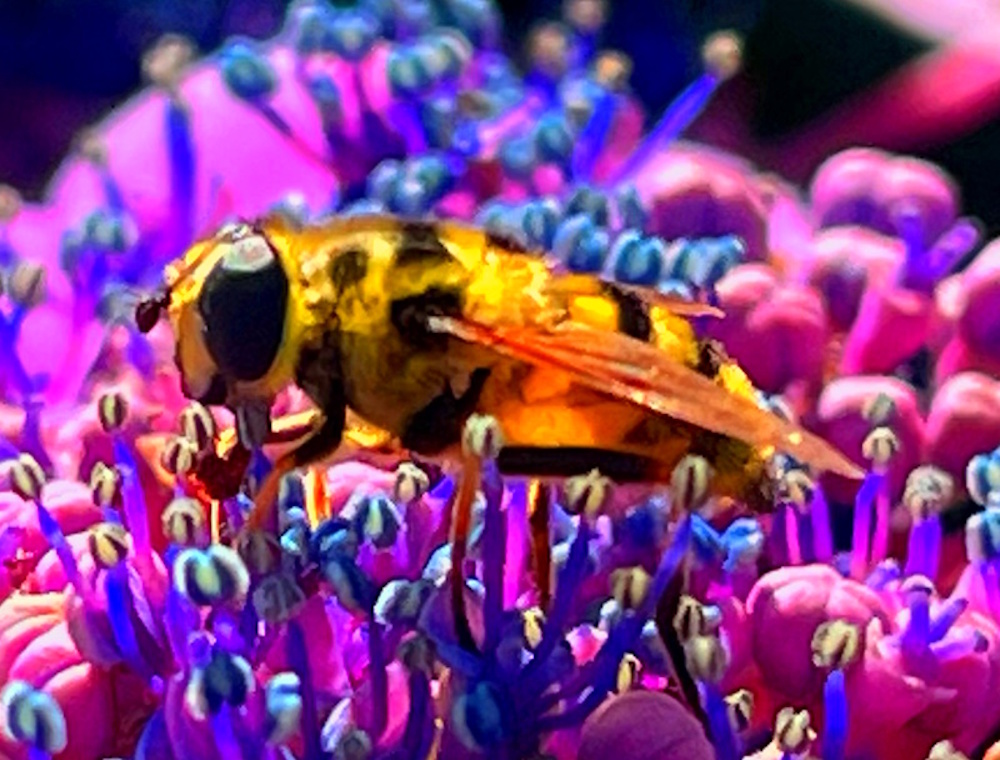
popular with our littlest friends. The Hydrangeas have been mobbed by Hover Flies and the Snowberries have been positively hopping with Bees. This is a bit annoying as I’ve had nothing to do with this. Something else that isn’t my
responsibility are the wildflowers that have grown in the new bed by the car park (it’s always
been the car park). If this was a scientific experiment the judgement would be clear — I am
the problem. Fortunately I’m in charge of writing up the data, so I’ll cover that up.
misty morning
mist
The west wind tastes of raindrops and the smell of autumn’s chill. The unseasonal sun had me
fooled into thinking that summer might be here forever, not so, the signs of its demise are all
around. I notice it in the early morning, at this time of year the creatures of the night are busy.
You see more foxes, they stop and watch you, then turn and walk away. There are rustles,
shrieks and ruckuses in the bushes, where half-seen things scurry at the edge of sight. The three
cats: boff cat, white foot and the grey nibbler, whose names and existence I’ve just the now
made up, seem to be out more. There’s always something beautiful to see — a sickle moon
holding a boll of darkness, a dropping mist, the first-fallen leaves edging the paths with crackling
amber.
There are autumn things to see in the day time too. The Ivies along the towpath are in flower,
although you wouldn’t know that from looking at them, their flowers are tiny, grouped in pale
green starbursts and covered in insects. That’s the giveaway, the mass of insects. Bees,
Wasps, Butterflies and Hover Flies, a never settling swarm, a swirling pattern on the ivy hummocks.
On sunny days the fish come to the surface, perhaps to see the world. This year’s fry are
bigger now, about six inches long; they loll, or wriggle and twist just beneath the surface. Now in
their hundreds, they were thousands once before. You don’t often see the bigger fish,
they’re too canny I suppose, but they are there. In the evenings the light is different, so
the water reflects the sky. On still nights ripples ring the surface and you hear the splash as the
fish rise to snaffle flies.
The Jackdaws are flocking up in the evenings, they wheel kak-kakking across the sky, to settle on
the chimneys for a bouncy caw-caw chat. I suppose that now they’ve raised their chicks they
can roost together and catch up with the gossip. The Pigeons are flocking too, sweeping the sky in bunches; they perch in lines on the student flats.
So, it being nearly autumn in my mind now, the garden club went over to The Grove to collect some
free seeds for our beds. A person from The Forge was throwing out some bags of mushroom compost. These had
what looked like bright pink Chanterelles growing out of them. The mushrooms made me think
about thick stew and evenings by the fire. Yes autumn will be here soon.
birds
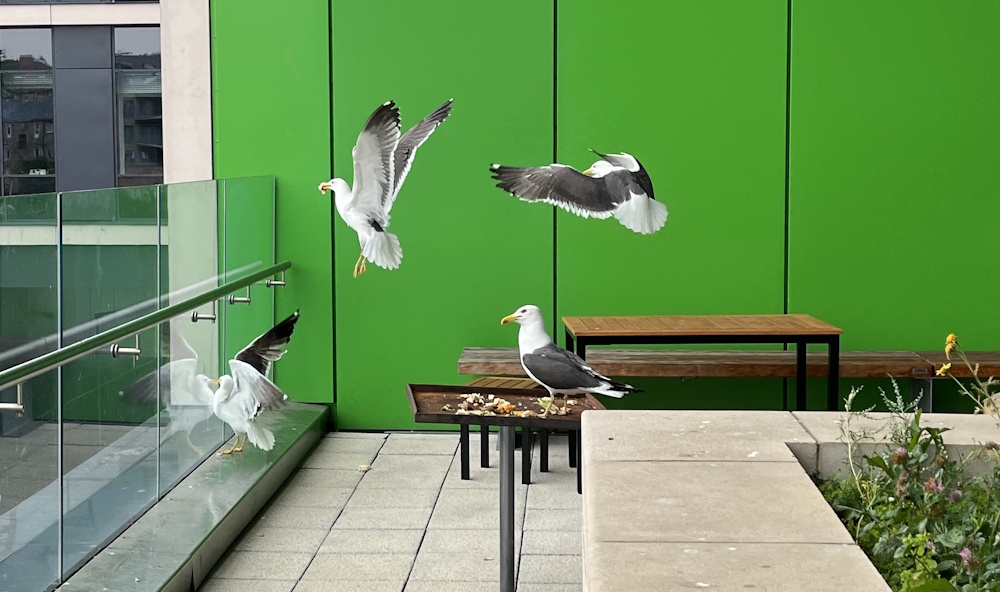
gulls being gulls
You’ll have had the experience I’m sure, you’ll be wandering around the building
meeting the same person, possibly someone that you haven’t seen for a while, again and again.
The extended conversation goes somewhat as follows:
—— Hello, how are you?
—— Ha Ha! We meet again…
—— We must stop meeting like this…
—— …People will talk.
—— Are you following me?
—— No, you’re the stalker.
And then you don’t see them for a year. It’s like that with me and the school birds, they
drop on and off my radar. Then something will make me take notice of them. Sometimes it, the
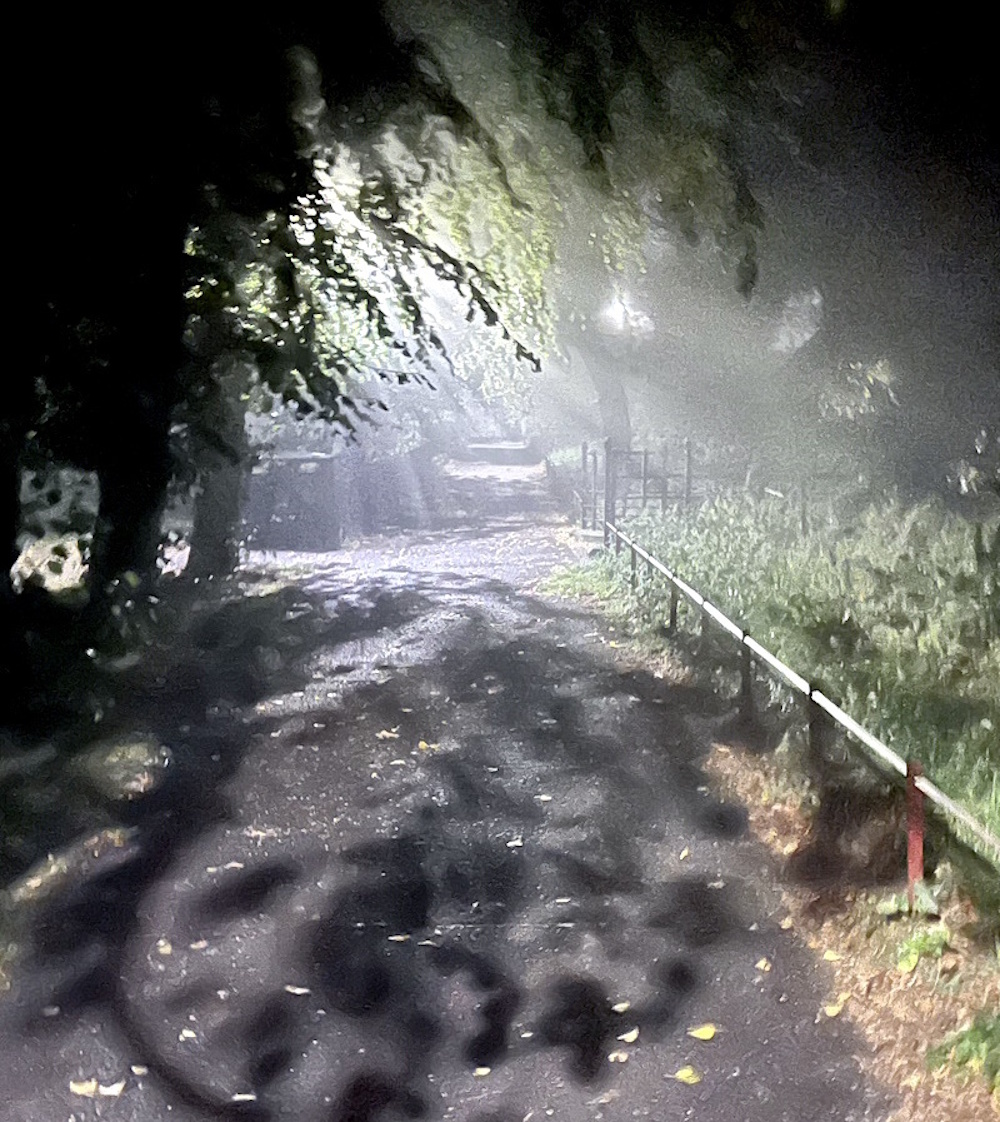
something, is just their song — one morning of fog when the world was, what I call, Sickert coloured, (my internal metaphors may not translate), I noticed the
barking of the Wrens. There’s another something, about early morning fog that
stranges the sound. I walked to work in a kind of dream, thinking of Wrens.
Seagulls never drop off my radar for long, they’re too pushy. Our local colony had six chicks
this year, a couple went to the farm we never visit, one in a rather spectacular fashion. I sort of
know the Seagulls, we’re on feeding terms, but they wish for more — they would love to
nest on the roof, which we can’t allow, so I’ve had to front them out up there. Neither
I or them enjoy they, but one of us has to be in charge.
There was a Jackdaw child this year. I have been feeding it cheese, Emmentaller, which I bought and
disliked, but it seemed quite happy with. Jackdaws, with their cornflower eyes and clerical
vestments are a bird that’s always around and never noticed. Like Pigeons. And Magpies.
For me, today, I saw my special birds, the Chinese school. I have been lucky with my life, for twenty
years or more, every Saturday of the autumn/winter/spring has been Chinese school. A drama of kids
and adults and a whole lot more fascinating things which I don’t quite understand. I’ll
try to wrap it up in a story. One I’ve told a lot, so we’ll use a blockquote.
It was Chinese new year, the Chinese ambassador was coming, it was that big a do. It was to go on forever so I needed to be
fed, this was to be sorted out. Now, I’m a vegetarian and a celiac, do you think I got
this across? I didn’t. The food I got was wonderful, not like any Chinese food I’ve ever bought. But meat and wheat featured heavily and I was very sick. Later. It was worthwhile I felt.
Not the greatest of stories, but that day I remember, as we should remember all our days. Look, look,
look, at this marvelous world of ours, for you will see your own birds.
garden
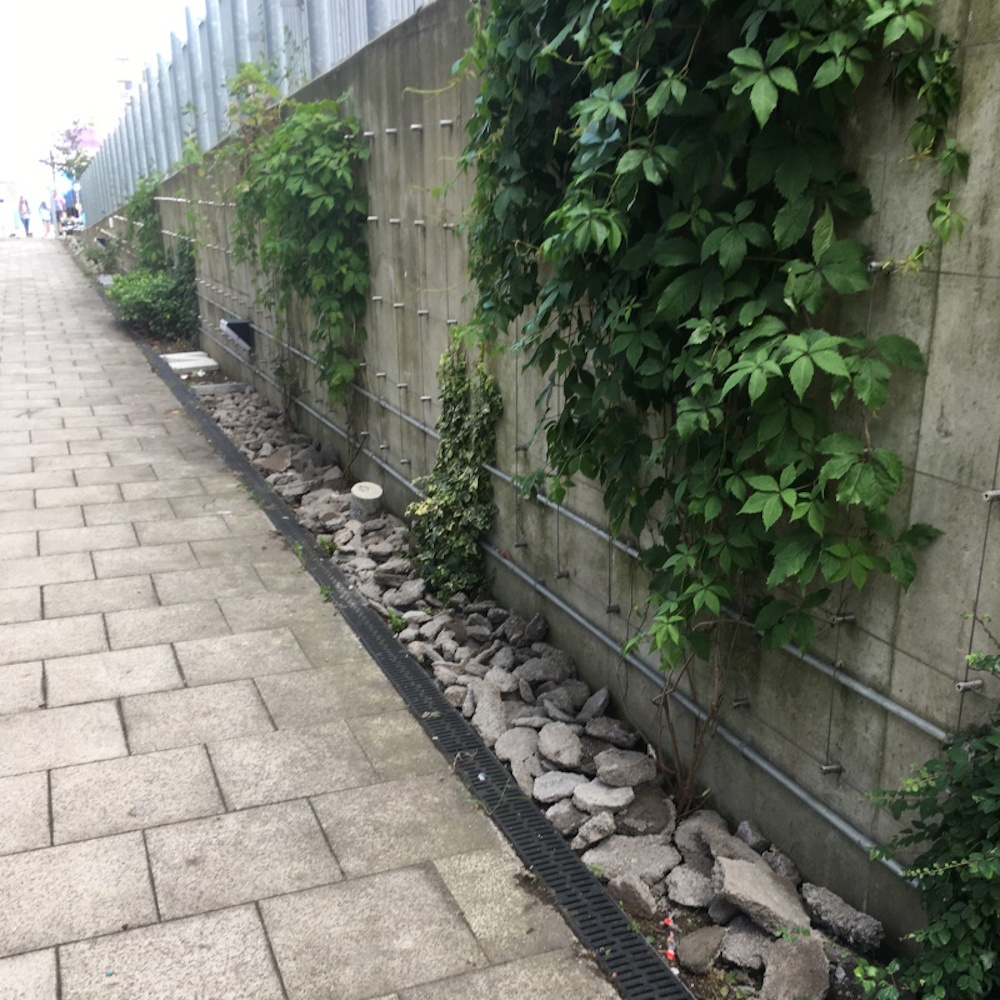
solar — last august
The sound, and meaning, of the word garden hasn’t come all that far from its indo-european
root: gher; to grasp, enclose. I like to think that this is because, like rivers and their names, gardens are such a vital
part of humanity’s pith. Something so fundamental, enduring and just outside your house,
that no bard’s spear-sharp new coining can ever steal the word.
There must be as many garden styles as there are human cultures, but all gardens have their walls,
however porous. The enclosure is an essential, of an inside being inside and the rest of the world
being out. A place where humans, and whatever nature personification they pray to, work to create a
paradise (and to thwart some bull-striding storm-god’s
plans?). For gods aren’t wanted in a garden, they’re a place for smaller sprites, the
lurkers in the bushes, the sippers of the milk. Gods, in their hubris, lay snares in trees, come
walking in the cool of the day to catch you and the missus, skulking in the Nettles, clutching fig leaves to your bits.
No! Gardens are a human place, for humans. That’s why we keep gods out with boundaries.
You have to be patient if you garden. And you have to cope with your special plants dying, or perhaps
worse, just grimly holding on to life, a constant reminder that you planted them in the wrong place,
or in some other way failed them. It’s a hard lesson that, that something living suffered
because of you. So you get careful, and a wee bit brutal. The plants that don’t fit get
culled. But you already do that with the weeds, so it’s not too much of a stretch. It’s
an odd thought, to be a gardener is to love plants dearly, and yet snuff out their lives without a
blink.
The joys, of course, are huge, and on a human scale. When something works the feeling is unique, that
you, with nature, made this, it’s a gladness unlike all else; to have been
part of the creation of this marvellous thing that has it’s own life. Best of all you
don’t have to be a special type of human to be a gardener, and cash won’t help you much.
You might never walk across Dolphins to save the Whelks, or paint the perfect dawn, you can
certainly plant some seeds.
From all this you will have gathered that I’m pleased with
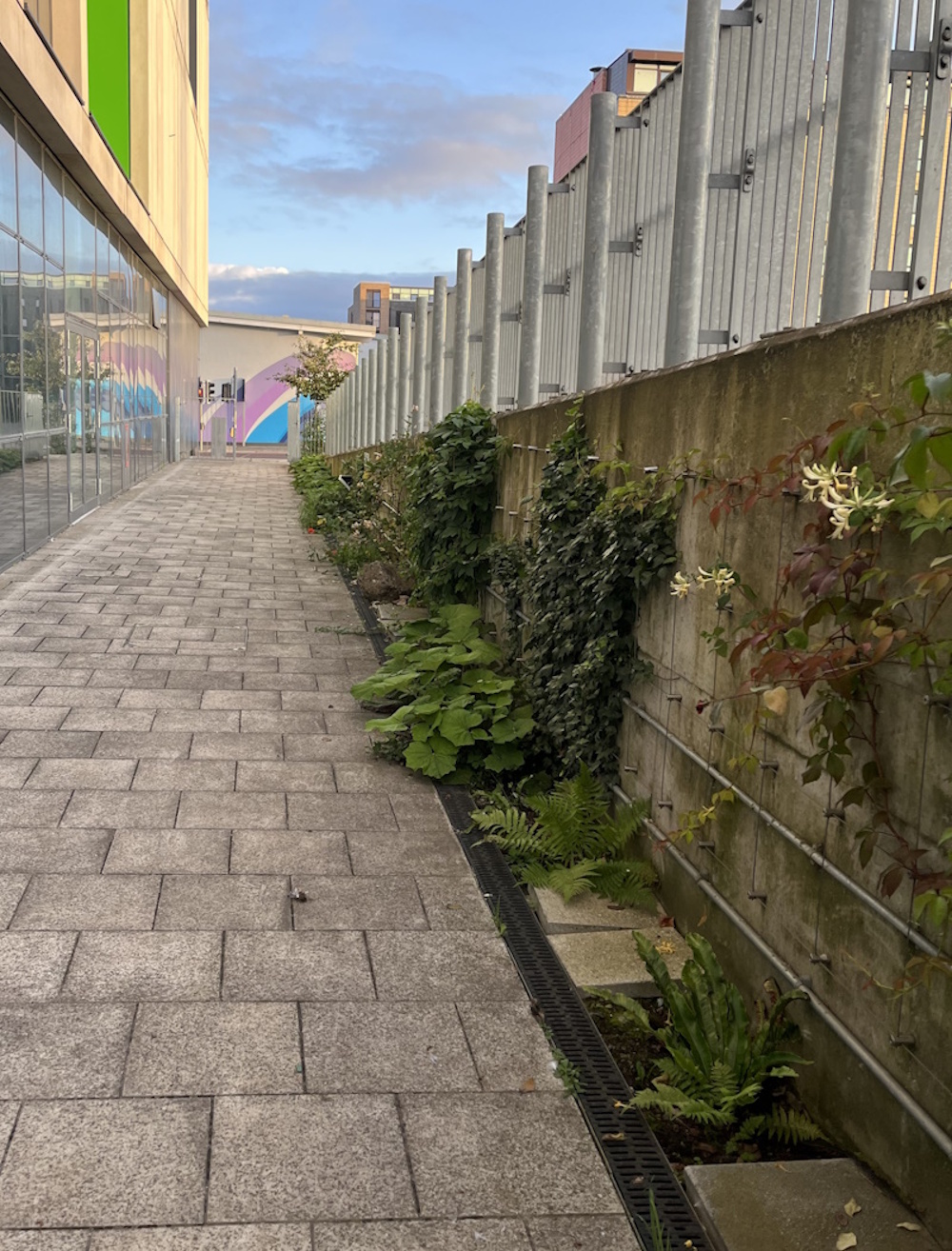
something. I am, the solar, it’s down the side of the school. It’s best in the rain,
when the Moss burns with pale witch-fire.
solar — this august
wild geese
geese
I was on the canal when the Geese crossed over, low and grey in a low gray sky. I knew they were
coming, in a sense, Laura had told me that she’d seen them, so it wasn’t a surprise when
they soared, southwards over the tenements, from a sound-shade, which is why I hadn’t heard
their entrance; for once their fuzzy-strange triangles came before their deep grey-psalm. I was
walking to work early. Today was a special day, it fitted my mood that all was gray.
My life has been, in some twisted sense about walking into schools, many, many, schools. When I enter them I take an instant balance, I say it’s from the noise, which is part of the truth, not all of it. I have senses I have no name for, I expect you have them too. To take the temperature of a school, to know
that all’s ok, all of us on-task, that the outside doesn’t matter, for the
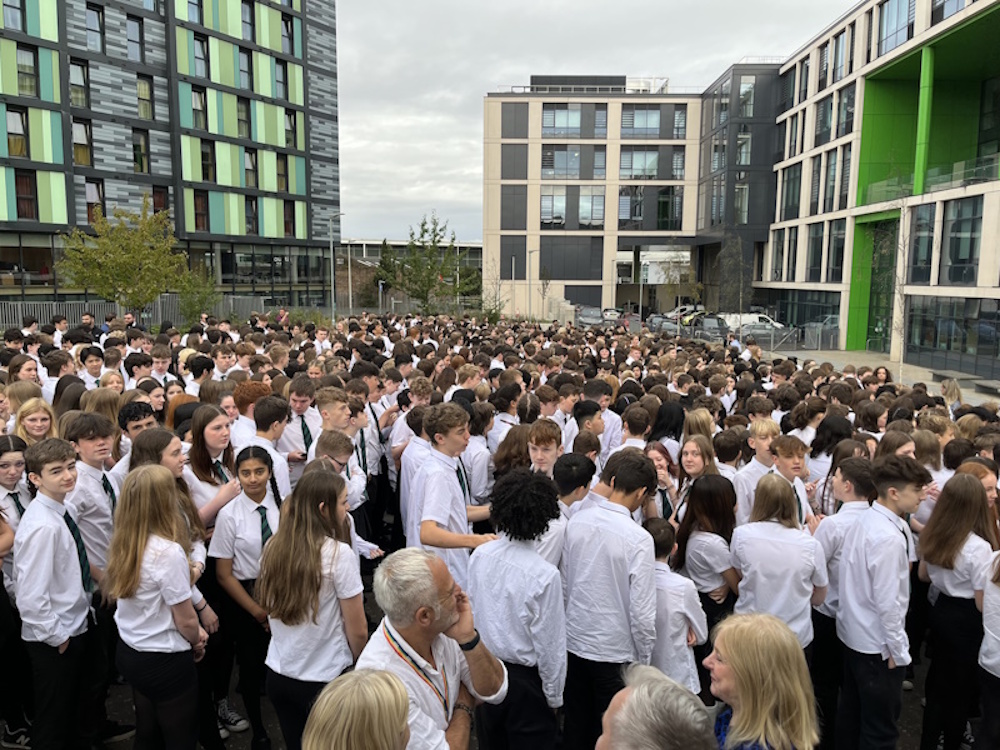
future’s amongst us here. And today we were going to do a together thing, a thing just once
awhile, the whole damn lot of us, standing black and white against the gray.
We did it our way: perfectly with ragged edges, for we must always find things fun, and with that
messy, lazy, confidence that springs from our inner fire. For we are vibrant people. Are we
special? I don’t say it, for we never do, have we something here that might not come again?
But we were busy, all at our tasks, shouting, strutting, strolling, then bouncing off each other to
form up once again. A whirling whirl of bodies in the process of becoming still.
I found Fee, grabbed her hand to make sure of her, this was something we must share, the evening of
our bright morning; for although she and I are grown ups now, that wasn’t always so. The
photographer whistled and we, the crowd, settled down. The lines were dressed and then the thing was
done.
Then we unrolled and went back about our business, in kitchen, office, or in class. Flat now but inner happy, knowing this had been something special, something odd, that would not come again. A smile on all our faces, our thoughts on stranger things.
I went home in a darkening, and had come, keys out, to my door, when I heard the Geese again, lost above me in noctilucent cloud, pealing in the night. Virginia, that perfect
Vixen, would say we have an internal wild horse, nope and no, it’s the wild Goose in each and every one of us that carries up our souls.
oak
I don’t know how familiar you are with the life cycle of the Oak. You know, the Oak, the mighty
Oak. That tree that grows somewhere in the woods and has bit parts in literature and furniture.
Something to do with acorns? You’ll know of Oaks of course, you can probably identify
one, and you know that it is from little acorns that they grow. You won’t have given too much
thought to it beyond that I suppose: acorn falls, tree grows. There’s a problem, in a good
year a tree will produce thousands of acorns, nearly all of which will be eaten by something. To
grow acorns have to be planted, a job for the fairies you would think, but apparently these do not
exist. Only acorns that have been buried, and forgotten, by Jays will grow. (Squirrels bury them
too, but they have the tendency to gnaw off the growing bit.) It must work, there are Oaks about but
the whole business seems a wee bit chancy to me.
Oaks support a whole range of life, there isn’t really a better tree when it comes to natural
diversity. Indeed it’s more than probable that they’ve helped support human societies in
the past — with proper preparation humans can make flour out of acorns, not enough to live on
but you could wrap up your sweet-and-sour sabre-tooth in an acorn-flour kebab. Tales of mystic nonsense have been
attached to them since the days beyond yore. It was Zeus’s
tree, and probably every other one of the rag-tag of storm gods who felt that they needed a tree as
the ultimate godly status symbol. Sacred groves of Oaks were brought to this country by Anglo-Saxon
immigrants, there druids could be found lurking, gibbering, looking like gandalf and clutching
sickles, so we are lead to believe anyway. We still kiss under the Mistletoe, that only grows on Oaks, during the winter festival of root vegetables. If there was such a thing as magic Oaks would have it. So why don’t we have any Oaks at Boroughmuir?
This is the very question that I asked myself. Aside from the fact that there aren’t any Jays
about I couldn’t think of a reason why not — well I could, but let’s not let
reality spoil our fun. Let’s plant our own Oak woodland, to shelter the herd of Deer that we
should get too. But I’m leaping ahead there. The gardening club planted some of the acorns
that I’d foraged. The whole plan has a pleasing level of stupidity, our chances of growing
Oaks approaches 0, as in no chance. Still, it can do little harm and, even in the rain, was fun to
do. And imagine if it worked! I’ll never really know, but in two thousand years perhaps the
Oaks will still be here and we’ll be gone.
A stupid plan needs a stupid story. Myths have to get started somehow, so…
Sorrow the pied purloiner stole the Oak berries from the world tree ooaapheely, which is just yggdrasil but with more vowels. Sorrow is a Magpie (one for sorrow) because
we haven’t any Jays. She stole them from under the scarlet cheeks of zogg the Goat’s
troop of heavenly Baboons to give them to the elves (the gardening club) to plant. She also stole
some Bluebell bulbs and Pea seeds. (The young adults are wonderfully eclectic when it comes to the
seeds they want to plant.)
One would think that people would understand that this is nonsense, but
modern life being what it is I fully expect it to be used by someone as evidence of a vast
conspiracy to pump us full of Goat hormones and take away our teeth. We might be lucky with the
Bluebells though, we’ll see come spring.
turn
fallen leaves on moss
Some lurgi struck me low this week. I spent two days lying in bed, sweating, listening to the rain
hammering for entry and the wind raging in the chimneys. When I rose from my sick-pit and returned
to the out it was cold and bright, it felt like winter. Coming back to work after I’ve been
off sick has always felt a bit of a wrench. When I was younger I’d often been skiving, so I
had to remember what illness I’d claimed, lie about my prognosis, and explain away the
black-eye. Today it was just the prospect of a day’s work that was depressing me.
It was a nice day, cold and windy but dry and bright. That autumn bright, flat and brassy and totally
without heat. It still is autumn, the leaves still roar and rustle on the trees, but there
are signs of winter. Some Blackheaded Gulls have arrived from somewhere north to spend their winter
break with us. Soon the Goosanders will arrive; the wives from hereabouts, where they have been
raising the goslings, the husbands from the fjords where they spent the summer avoiding such work.
We seem to have acquired a single Swan. One of last year’s signets it’s been about all
summer, looking regal and lonely, begging for bread. It would be nice if it would partner up and
nest. There’s also a tortoise-shell cat lurking around. I see it checking out the undergrowth,
boding no good for our wildlife. There’s Cats all along the canal, both sides. We were always
going to get a Cat, this one’s young and probably won’t do much harm.
Because I’d been off I hadn’t planned anything for gardening club. So we just took a few
tools and flailed at the undergrowth in one of the raised beds. If asked we could say that we were
clearing it. A nice thing about gardening together is that you can talk about gardening. We talked
about what we’d like to see/make happen in the playground and came up with a plan. Actually we
came up with few plans. The one that we all liked best was to plant bulbs in the raised beds —
something long-term with an immediate impact. The best thing is that you can help — if you see
any spring bulbs in the supermarket, buy some and put them in the bucket on my desk. This plan does
look like working.
gold
On still days the world is golden. The low sun swaddles everything in a wan golden light. One that
gives no warmth, any wind that blows rattles my bones. The paths are strewn in gold and I wander
home dreaming of buttered crumpets, and of reading by the fire in my jammies. Scuffing through the
leaves humming I feel like a young adult in a nineteen-thirties kids book. Where I’m wearing shorts, sensible leather shoes, owning a satchel, having a sister to whip up lashings of ginger beer and about to have a jolly adventure involving goblins. Then there are the days of rain, where the sky is a sponge that comes down to chest height. Everything is water, from the puddles in the potholes to the water gushing from my hood. But especially the water seeping up my trousers, my legs are so saturated that it hurts to lift them. The only adventure I’m up for then is a warm bath.
At least this year we had a proper autumn, last year’s drought — fimbulautumn,
where plants changing colour signaled that they were dying, and the only healthy vegetable seemed to be the lettuce that was racing the PM to who would rot first. This year the trees burst with joyous fire in the sombre skies and there’s a reassuring
smell of the right type of rot in the air.
The Gossanders are back, both ducks and drakes. I wonder how that conversation went? The females have
been raising the kids, the males have been partying in the fjords.
—— Quack! Where have you been? You only went out for a can of sardines.
—— Quack! I’m literally not going to lie. Basically I ran into Donald and Daffy, they were
going to visit some friends:
Huey,
Dewey, and Louie
obviously the next thing I knew I was in Norway with no credit on my phone.
He shrugs his wings sheepishly.
—— Quack! You are a giant arse.
It’s probably a good thing that the males sojurn abroad, there can be only so much fish in
these parts and it must be tough feeding a growing gaggle when dad is porking all the big ones.
Male Gossanders remind me of those middle-aged men who grow beards and curly moustaches, wear
tight tartan suits and mince about in winkle pickers. They must use some type of harness on their
faces when they go to bed, lest they puncture themselves in the night. Not serious people I think,
you couldn’t see them reading the news or running the country, could you? That said I was
watching the Covid enquiry the other day, involving people who actually had been running the country, about the following was said —
—— Why did you not disturb the prime minister on his holiday when you knew that things
were serious?
—— he would have just made elephant noises. Which would not be helpful and would have
frightened the under secretaries.
And then we have hat man-cock demanding the power of life or death over the hospitalized. Jings. Who
would even want such a heinous responsibility? I’ll bet you could hear a pin drop in the
meeting where he announced that. Forcing him to eat Kangaroo anuses no longer seems punishment
enough. Not that it ever did.
Time to get ready for the quiz. I’ll try and get some betting going. If I know that one team is
not going to win (my team) it should be possible to make a Dutch book.
Throughout my life I’ve spent some time rearranging the contours of my past. Sometimes I do this to tell to others, (if you’ve been paying attention you’ll have noticed that some of the things that I’ve written here directly contradict some of the other things that I’ve written here), but it’s mostly for myself. I’m not lying really, I’m just orchestrating the feng shui of my history to make a more pleasant sound. I did that thing because of something, and that happened because of that; my reasons for doing such-and-such were laudable, not squalid and debase. It’s a dangerous game because one change leads to another, if I’m not careful I can end up telling myself lies. I don’t do this with the really bad stuff — the type of memory that strikes out of nowhere in the darkness, and curls you up fetal, please tell me I didn’t do that. Fortunately I can’t get shot of those, otherwise I might.
Why do I do this? Make this curation (that’s a nice weasel word). I suppose it’s to make a coherent story to my life; to provide an over-arching narrative to a series accidents and random events. So that my life has a purpose that it doesn’t actually have. I’ve always felt a wee bit guilty about what I’ve done with my life. When I was young I wanted to make a difference, to, in some small way, leave the world a better place when I left. There’s fat chance of that. I let myself off because I’ve worked in education, where, if I haven’t done too much good, I’ve done little harm. But I fell into that by accident, and I could have made more of the opportunity. I haven’t been useless. That’s the best I can say. So I big up my triumphs and minimize my disasters, jings what I a sorry tangle I’ve woven in my head.
Still, other people do this rearranging, I know because I’ve seen them do it. One time the boys were involved in some semi-correct discipline (I remember what it was, but I’m not going to tell you). We came up with a semi-true story, which would sort-of get them off. Over time this yarn became the truth. And then that was embroidered upon, eventually what we said had happened was just a bunch of lies. But the boys really believed it. They’d even argue with me about what had happened, they’d get angry with me for telling lies. I had been there, I remembered us coming up with what we were going to say! I don’t want to end up in their position with myself.
I write this now, as a warning, because we’re about to take a dip in my memories. What follows is the truth, as I remember it, mostly. In places I’ve perhaps exaggerated, or tweaked things to make a better story. I did this above in the piece about the Brambles. Everything in it happened to me, but I have conflated events to make a better story in places. None of it is an actual lie. Except for the café bit. There were Rastas a-plently in Stoke Newington in the eighties, and I’m sure that they played dominoes and listened to dub, but I never had a bacon roll in their vicinity. I put it in because the story needed something and that felt right, it’s just an outright lie. I’m a writer, I’m allowed to lie.
So we’re agreed that I’ve now decided to retire? When you’re going to retire you think about the future, but you think more about the past. You think about the past because you become aware that the things you are doing you may soon do no more. So you start thinking about all the times you’ve done them. And when you started doing them. So let’s recall my working life…