And as he journeyed, he came near Damascus: and suddenly there shined a light from Heaven:
Acts, Chapter 9, Verse 3
Dad’s death affected me in ways that I hadn’t expected. I’d expected to feel sorry, to miss him, to have those moments where I thought that he was still alive. To feel much the same about his death as I’d felt about mum’s — to treat it as one of the inescapable things that are part of life — something that, if it was never going to go away, was going to fade over time. What I hadn’t factored in was that him being alive had kept mum alive too. Now that he was gone they were both gone. It was as if mum had died again. The loss was greater, it hit me harder.
I have the usual Anderson hardness around death — we aren’t unfeeling, we just aren’t sentimental about it, we treat it as a normal part of life. Part of this is down to our longevity — we die, with our facilties, in our eighties or nineties, after having had a, good kick o’ the baw. Our deaths aren’t tragedies, our times have just come. Another part of it was grampa’s attitude, he was at home with death. He’d been on the Somme and the salient at Wipers, two of the more accomplished of the hells-on-earth humanity has created for itself. He’d told me stories; of people falling off the duckboards and drowning in the mud; of his mate being blown to bits next to him, showering him in blood and bits of his head, blood and bits that he couldn’t get off until they went down the line a week later. Death didn’t hold any mysteries to grampa.
Grampa could be an evil old bugger, he was well aware that other people weren’t so comfortable around death. He still brought it up often. He had an actuary’s grasp of the statistics around popping your clogs. I can still see him in the clubhouse outlining a very poor prognosis for some poor old git who had a mild cough. Sometimes he went too far even for my mother, who loved this side of him, as a new mother of nineteen, with me in the pram, she’d listened as grampa and uncle Bill Handyside swapped their stories of Gallipoli and the Somme. She was horrified when he announced loudly, at some funeral, that, there’ll be a damn good clear out here this winter to the group of ancients grouped around the coffin as the minister was intoning the dust-to-dust bit. He was, at least, right.
Mum, although a Somerville by birth, had died in proper Anderson fashion. She was only just eighty, a wee bit on the young side, but we’d forgive her for that. In the end it was another cancer. I think that she’d been ill for a while, or had known what was coming; looking back I can see that she had been making preparations to be no longer there. There was some talk of treatment, mum dismissed this out-of-hand. She’d been through chemo before and didn’t want it spoiling her last days. She faced death well, she showed no fear, and apart from one terrible night, she didn’t let the pain show. She died as she lived, showing a brave face to the world.
By the time she died mum must have seemed, to outsiders, as a typical Morningside Lady with her book clubs, her quilting and sewing, the visits up to London, exhibitions, art galleries and the opera, having coffee with friends. She was all that but it was by no means all of her. Mum had been born working class — her father was a plumber, they lived in a council house. Marrying dad had been a small step up — dad had been to university, grampa owned a house and had a lawyer.
——A lawyer! What does he need a lawyer for? My grampa John, a good socialist, had been outraged and deeply suspicious.
Mum and dad bought the house from grampa when I came along. If my dad had any plans to set up a domestic tyranny along the lines of my grampa he was disappointed. Once Coco and I were safely at school she took night classes and trained as a teacher. The job for which she had been born. She was deeply loved. She got her first job at St. Peter’s, a catholic school; even late in life if we visited an Italian restaurant there was a danger of the kitchen emptying to stand round our table —
——Aah misses Anderson, we will start off some Polenta, and Zabaione after, no?
She was set up to play the Morningside lady — the cottage with garden, a job in teaching, she wore the right clothes, cardies and culottes, she had a Lorgnette. She played it quite well, but it was a bit of an act. She always had a queer lack of confidence in herself, something in her background made her feel a fraud. She undervalued her talents, she undervalued herself. Nothing she achieved and nothing we said could change this. Her brother, uncle Tom, put it down to her parents’ neglect of her education, they gave her no encouragement, they made her leave school at sixteen. I only knew the woman, he knew the little girl, so I suppose that we’ll have to bow to his judgement in this.
It was difficult to be unhappy when you were around mum. Everyone felt this; Coco and my friends visited to see her, rather than us. She had a fine taste for gossip and character assassination, she told stories well. Any mildness in her pronouncements being belied by an arch of the eyes and a wicked slant of her mouth. She was always the centre of attention, even when she wasn’t talking your eyes were on her, she dominated every staffroom that she was in. And, of course, children loved her.
This ability to make people happy and her magic with kids were writ large in one of my final memories of mum. She was in hospital, waiting to go home. There were four people in her ward, two at death’s door, one, much younger, was sat up in bed across from us talking with her wee boy. He was unhappy about something. I found out what this was when mum had finished waggling her leg in the air to show off her new pressure socks — he had to give mum a bunch of flowers. He came over in halts, every few steps he looked back at his mum for support. She would nod smilingly and he’d manage a few more steps. I went over and thanked the mother, by the time I got back he was mum’s new best friend. Happy now, he even waved to me when I left. Even at the very end she was brightening peoples’ lives. She died a week later.
Now, with dad dead, they were gone. There was a void in my life, a piece of the ground that I’d stood on had crumbled away. They had always been a part of my life — a bulwark and tether, a fixture. They’d been part of my background, something I rarely needed, but there all the same. I missed them far more than I had expected to.
Grief is like a burn, sharp at first, it fades; it still stings when you poke at it. I’d see, or hear, something I must share with mum. For I’ll always be the wee boy who wants to run and show-off to his maw. Or I’d come across an article, or problem, that I wanted to talk over with dad. That brought a twist in the gut as, again, I realized they were gone. And there were those memories, that every happy family must have, of times spent together, where something happened, that get brought up again and again. When I thought about those there was something new, and mum and dad were missing. There was guilt too, how much of my sadness was about me being no longer young?
I have no regrets, there wasn’t anything I wished now that I’d said to them; nothing that I wished I had, or hadn’t done. I wasn’t angry that they’d gone, we all must go sometime; I’d have wished for them to have stayed around longer, but what use was that?
So mum and dad were gone, their lives over, I started to think more about my place in the world.
month
néodspearuwan moon
I was wandering the playground, pretending to be working but really just seeing what was happening in our little part of the natural world, when it occurred to me that we call the time about now spring because things are springing into life. Actually it pretty much is, although I was thinking about the verb rather than the noun. I approve of the literalness, it’s
a wee bit like the French Republican Calendar — breezy, rainy, hot, slippy…
Spring, the verb, works for the flora, the vert, it’s not so apt when we are talking about the fauna, the venison. Fauna around here mostly means birds at the moment. If we discount the dogs, which I think we can for our purposes. The birds are astir.
Dawn is about six-thirty just now, so I walk to work in the dark, surrounded by spring noise. It isn’t the fully immersive dawn-chorus wall-of-sound yet but it is noisy. Mostly you hear, and see, Blackbirds, they’re always
quick off the mark in the spring. But other birds are busy too. The Mallards have started to fly around in their squadrons, I’ve seen the Goosanders pairing up. The black-headed gulls are developing their eponymous head, they’ll
fly off somewhere to breed soon. The, bigger, Herring Gulls who will be the Gulls of our summer are starting to arrive. The Sparrows seem to be interested in the hedgerow again, I’ve seen them chasing about there a few times.
I don’t think they nest there, but they did use it for their offsprings’ flying lessons last year.
Now. Did you imagine that when I got started on the etymology of words that I’d tarry in the portico of the rabbit-hole? Of course not. Rabbit-holes are like steamed puddings, the best bits are at the bottom. I went searching for
an alternate Old English word for spring; one reflecting the active/busy doings of our local avians. There is an old word for spring — lenctentima, from Lent I assume, but we need something more poetic. Fortunately Old English is a storehouse of wonderful words for bards.
I’ve settled for néodspearuwan, meaning active restless sparrows in honour of our own little birds. It won’t really do for the whole season, so we’ll just say that it’s our word for the time of the second moon of the year when the sparrows are… As a bonus we now get to name eleven more Mo[o]nths based on what we see going on in the playground.
the dream
my dream hedgerow
Since I’ve been a janny my dreams, those that I have when I’m asleep anyway, have been very predictable. I don’t remember having any dreams as a young adult, I must have had them but none of them seems to have been interesting enough to stay with me. Nowadays I remember my dreams quite well. The broad outlines and my feelings of helplessness anyway. Said dreams come in two categories, both involving some school, mostly an imaginary and peculiar one. Towers, turrets, tunnels and underground lakes peculiar. The first kind has me struggling to lock up a building, one of many doors, full of people; sneaky people who don’t wish to be locked out and are as biddable as cats. The other has me discovering some part of the building that nobody knew existed. There’s often a pool. Which is unsettling as somebody has been looking after it, I know all about empty buildings, they crumble fast. It doesn’t take a Freud to winkle out the hidden meanings here — these are stress dreams, loss of control and work undone. As if to compensate the dreams that I make up for myself when I’m conscious lack neither range nor crazy, so usually I don’t share.
I had to share a part of one of my (waking) dreams this week with Derek from our Parks Department. I was with the Bee and Wildlife sub-group of the young adults’ ECO group; Derek was here to help. The discussion ranged widely, we talked of hedgerows and paths. We agreed not to cut the grass this year. This may not sound much but not cutting the grass is almost the most important part of the plan. What plan? I’ll tell it as a story, stories have power.
The dream came to me during the lockdown, remember that? Alison and Helen (who used to work in the kitchen), were sharing a socially distanced bottle of wine by the lawn. I was lying in the grass, which hadn’t been cut all summer, it was thick, rank and spiky; there were daisies and buttercups. Bumble bees and flies, butter, damsel and hover, flitted, hovered and bobbed. It was hot and sunny. There was a smell of straw and green with a background warm sweetness, if we stopped talking we could hear the rustle and hum of insects. I must have been thinking about the playground because I had a moment of sharp clarity. Certainty surged into my mind full formed —— yes, this is it, this is what we want, loads of insects. The blocks of my dream playground, that had been swirling in the vaults of my mind for a while, tumbled into a whole. I saw the playground entire and what I’d have to do to achieve it. Well that’s the story anyway…
But it’s simple really: more grasses means more insects. We want lots of insects. That is the dream.
reincarnation
crow
… When it’s raining, especially when it’s lashing it down, people often say to me, ‘Nice weather for Ducks’. People do say the most fatuous things but when the biscuit is handed out for dumb things to say this is a strong contender for second place after, ‘it’s a braw bricht moonlicht nicht’. I’ll own that the affairs of Ducks are subtle and they are quick to quack if you meddle but I can tell you, from long observation, that they hate the rain as much as we do. ‘But they are waterproof’, people wail when you point this out; well so am I, I like a nice bath, I still don’t care to be soaked by some random liquid that drops from the sky. I would not like to be reincarnated as a Duck.
Reincarnation, or metempsychosis to be posh, as I understand it, works a bit like this: you do good things; you get to come back in a higher form; eventually becoming so good that you escape from the torment of here. (There is such a thing as overshooting — being so good that you have to come back as a sprul-sku Lama to help others. We’ll ignore that. But there’s
a lesson there I think.} Do good things is a bit nebulous isn’t it? How evil can a Ladybird be? So we’ll leave that too and concentrate on the higher form stuff. It isn’t made explicit but richer more powerful human seems to be intended. I can’t help but feel that this is very convenient for some people…
——I am the naughty nabob of nantucket, I was born thus as a reward for my great merit in a previous existence. If you have issues with my riches take it up with my religious advisor.
——What? That man in the metal hat with the big axe?
——The very fellow. The hat is a simple against mind control rays, the dogmas require it. Or he may be off his chump, but he does have the axe. So you get the point, or the edge in this case. He signals the court to erupt with laughter, which they do, the nabob is known in nantucket and far beyond for his mordant wit and for munching on the tripes of the heterodox. He had foresworn Lampreys on medical grounds.
No. Let’s make up our own version, a no-fault reincarnation if you will, where you get to choose what you want to be next. (I realize that this isn’t practical, whole phylum’s would get no takers; who would wish to be a worm?) I think I’d choose to be a bird. For the flying mainly. But what kind of bird?
I am a janny and share the sins of my tribe, so Wood Pigeon is a strong contender. Fine sonsy birds who seem to do little apart from some clown-o-batics in the bushes now and again. They’re the most chilled of birds. Ambition
neo, I thought, become a crow. I took the photo…
…is it just me or is there something a wee bit suspect about that photo? Take a good look. Does it remind you of…? Then I read back the rest of what I’ve written here and I realized that it’s just me being me.
That cheered me up until someone said, ‘nice weather for Ducks’…
culture
jings
There’s an old Broons cartoon, which suggests that even in the nineteen-fifties Edinburgh was seen as a multicultural place. At least viewed from the braw-pots of bonny Dundee. As a teenager in the seventies I’m not sure that I experienced it that way. For me it was a boring white,
heterosexual, monoculture
with bad music and a sprinkling of random violence. People may have been having fun but they
weren’t sharing any of it with me. Now Edinburgh is a multi-cultural city, I hear a dozen languages on the shortest of journeys. This old town hosts a marvelous mix of humanity.
I love to see the sharp-hewn Polish lads having an evening stroll along the canal, with their cans of lager and their
elegant women. To see the barbecues, of every stripe, in Harrison park; African, Indian, Pakistani,
Chinese, different smells, different sounds and different ways. The sound of happy children is
universal, of course. Best of all I love the beautiful Japanese children, in their pairs, so
elegant, so happy, wandering, smiling and chattering away in their bird language. Occasionally you’ll see one dressed to the-tens in full anime, leaving a trail of smiles in their wake as they stutter along. I like that Edinburgh. I like that everyone feels welcome, that everyone can feel that they belong.
I’m told that I’m wrong to feel this, by loud angry white men in loud angry suits or tattooed baldies in England tops. I should be up in arms about the collapse of my culture. These foreigners (even the ones who were born here) are stealing our jobs, whilst living on benefits, molesting our women, out-breeding us, and importing their barbaric religions. I must say I hadn’t noticed this. The people that I’ve met seem pretty much the same as me and the only people who bother me about religion are American mormons, who are nice and polite but have scary eyes.
What do they mean by my culture? They’re never exactly clear. They seem to hark back to an imaginary past — one where we were all white and… what? Worked down pit? It, this thing that’s in danger, also seems to be pretty much English. Now, I’m Scottish, the English have been trying to erase our culture for the best part of a thousand years. And yet we’re still here, being Scottish. So I don’t think that my culture, whatever it is, can be all that fragile.
We have a long, and for some people, proud history of being unpleasant to foreigners in this country (A good overview is Bloody Foreigners by Robert Winder). Perhaps this is the part of our culture that’s in danger? We aren’t being unpleasant enough to foreigners any more. People complaining about immigration always stress that, they aren’t being racist. Fine. But I’m suspicious. If that were so why, when they hold rallies to protest, which is their right of course, do they hold them right outside migrant hostels? The possible violence and intimidation doesn’t enter into their heads?
At least living in Edinburgh I’m spared the, London doesn’t seem like London any more nonsense. All I have to do is to whip out my Broons cartoon. No true Scotsman would dare dare to doubt the holy writ of the Broons.
spring
worm
I know that I’ve been wittering on about spring since the beginning of winter but it is, finally, really, here. It’s official even, the equinox was on Monday. Everywhere you look, listen or smell there are signs. Spring is a blink and you’ll miss it season, our friends in the biomass of living things that aren’t us are busy. They have their progeny to begat.
Did you know that the moon that’s just been was called the worm moon? No neither did I. Being compelled to be me I looked up Old English words for worm. Surprisingly many; for the worms that make their living inside of us anyway. Poor Anglo-Saxons. I don’t think it was intestinal parasites and the denizens of our buboes and pustules that they, the moon namers, were thinking of. I think they had in mind worms more like the one in the picture above. There are loads of these just now, commuting someplace by night. It will have something to do with procreation.
starlings
murmuration
Above is a picture of a Starling murmuration. In the evenings you can watch these from the sundeck, where I took this photo. It was a bad picture, so I adjusted it to better reflect what I was seeing inside my head. I suspect that the reason behind these murmurations is simple — it’s a Starling party. You can tell by the noise.
symbols
fetish
The above, items I’ll call them, for I’ve no idea what they are, have appeared in the trees in the upper part of the playground. At first I was mystified, then I recalled that on Saturday mornings Christians of some stripe have set up a booth, or tabernacle, from which to proselytize and distribute tracts. Fairly tasteful as these things go but it must have annoyed the local Pagans who have hit back with the occult equivalent of a strong poster campaign.
coltsfeet
colts-feet
The Colts-feet, in the Solar, are coming on. It’ll take a few years until they look like how I want them. If they ever do.
When I was the janny at Craiglockhart I got to read the school log book. It was the centenary and such things were being looked out. The bit that interested me most was a visit of The Elders of Supreme Presbytery of The Church of Scotland
to examine the children on their catechism. That sounds fun. Each Elder, for they were legion, had written a couple of paragraphs of complaints and suggestions for improvement. Apart from one, he (and I’m sure that he was a he)
just wrote, ‘a start has been made’. It’s like that with the Colts-feet.
crows
balthazaar
Balthazaar the Crows (recall that all Crows around here are called Balthazar, the double-a is the plural) have taken to leaving us offerings above the automatic doors. I have been feeding the Crows, while shouting, ‘Balthazar’. The idea being that they will associate the name with being fed and come when I call. Then, if I became involved in a squalid argument with some jakey, I could call down the local murder. That should settle things: what fool argues with a man who commands Crows?
I may have to re-think this. They might start honouring their dead, making hats out of crisp packets and hatching a priestly caste. If they start developing a civilization we’re in trouble — they’ll domesticate us, coral us into Swedish furniture stores and force us to eat worms. That might be what we deserve but I, myself, do not fancy it.
In other bird news the Black-headed Gulls have left us this week. They were there on Saturday, on Monday they were gone, off to summer in the fjords. Spring really is here.
yellow
willow
It’s sakura season in Japan just now. When people picnic under the Cherry trees, drink saké, get lightly sozzled and admire the blossoms. It’s termed hanami
— flower watching, a metaphor for the beauty and brevity of life. Culture is rooted in people and place, often it does not travel. For example,
lightly sozzled is nearly impossible to translate into Scots. But I do think that we could pluck a blossom from an
ukiyo-e (ideally by Hiroshige) and pause to exalt, in our dour Scottish fashion, the ephemeras of our own spring.
Just now is the yellow part of the season, soon to be gone.
Wordsworth would not have to wander far to stumble upon a golden horde of Daffodils in these parts. Their very ubiquity dulls my appreciation of them if I’m being honest. There’s something too brash and ‘put there’
that spoils them for me. I prefer the Celendines and Colts-feet clumps that dot the edges of the canal. Best of all are the Willows by Harrison Park. Their branches: louche yellow ropes, swathed in pert leaves and tight catkin chrysalises,
dripping off fat raindrops as they eddy and sway. There’s a bench under one, where I sat and wondered, in the stillness of evening, one very gray day.
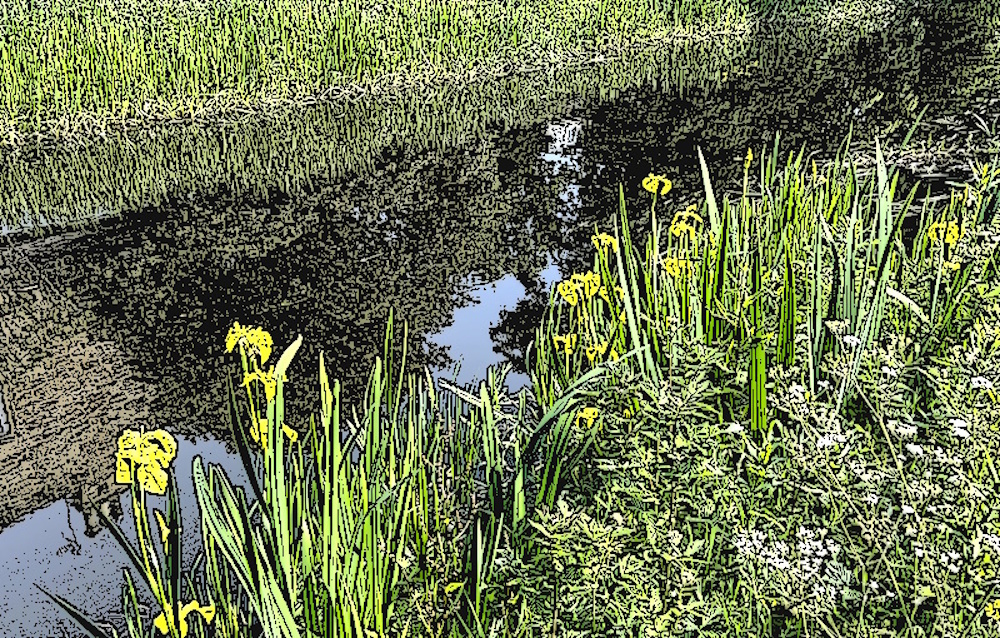
Later in the year there will be other yellows; Irises come to mind, and of course Dandelions. But by then yellow won’t be the only colour in the the world. Just now it can seem like the only strong colour around is yellow, and it’s
almost all of a singular tint — some strong Sulphur or Cadmium pigment, brilliant, bright and lustrous on a muted ground.
All this yellow brings to my mind Vincent in Arles, living in his Yellow House as winter turned
to spring. There he would start to produce those works, full of yellow, that we see as typical of him and love so very well. Maybe it’s just me looking forward to getting our playground back, our forthcoming art exhibition and
Brufts, but our bit of the world seems to be opening out before us in the way Van Gogh’s did in Arles. I anticipate a summer of warmth and life, of weeds and wild things, of colour and birds. Of mist in the mornings and soft
rains on starry nights. I picture myself watering the sundeck in a livid red sunset to the screeching of Swifts. The extension has nesting boxes for Swifts, I see an omen there.
Of course Vincent ended that summer locked in a sanatorium short of an ear. I’d give up a lug to paint like Vincent I think. I’ll settle for my perfect summer, that way I can still wear glasses.
what I did in your holidays
dawn on the canal
When I was at primary school Mondays started with an essay — what I did at the weekend. There was a special jotter for this, sized crown octavo and covered, in my case, in a purple-patterned flock wallpaper; a remnant from an ill-judged re-decoration of the front room, an example of my parents’, and seventies, poor taste. I’m not sure why my teacher, fierce, tiny, Mrs. Sobecki, of the flashing eyes and unerring aim when it came to the throwing of chalk at our heads, made us do this. It wasn’t make-work, it was marked, and the silver and gold stars, that were our reward in those days before house points, were given out. This was important stuff.
I do know that I thoroughly enjoyed making up a load of lies to start off the week.
I once claimed to have synthesized nitroglycerin, from cough medicine and nitric acid, in my imaginary chemistry lab (this featured heavily in my prose at the time), and of using it to blow-up something; I forget what exactly. I’m sure that if I wrote this now my teacher would be referring me to Prevent as part of the multi-agency response to my being crazed and bonkers.
I don’t know what brought this to my mind, or why I remember writing that particular story; I have been reading Proust and eating biscuits I suppose. Such things do have their dangers. Whatever. I’ve decided to revisit
my youth, what follows are some of the things that I did during your Easter Holidays.
The grand piano is no more. This, object, was a gift from someone. It has been with us, perched on two legs, mute and gathering dust, for some time. When it comes to gifts it is not only the Greeks that one should be wary of — everyone’s
motives are suspect. In my experience gift horses come riddled with colic, their mouths chock-full of carious teeth. Sometimes I think that the school is just an oasis on some secret silk road, an artery for the world’s dross.
Where caravans off-load their garbage and let their camels pee on our toilets. Recently one company had the effrontery to send us several crates of out-of-date hand sanitizer. Such people are monsters. Have we no hero to seek out these trade-hags in their gold-girt corporate lairs? To hirple and hasp them, and hoop them with steel. We could reward them with poem and bright-mead from our hives.
One reason for getting rid of the piano was to create space for our new barista station, finally they have a proper home in the Social Space. This always was called the social space but nobody ever called it that. Now that it is,
a, social space we’ll call it that again. After only five years every part of the school now has a proper name. Although some of those names you don’t know yet.
Some work was done in the playground, where I harassed by Mallards. At this time of year the Mallards act oddly, for Mallards that is. Usually a Duck of the towpath, they’ve taken to the fields, when they aren’t flying about
madly in flocks. You find them sitting on walls, dangling on branches and pecking our bike sheds. I caught a couple trying to get into the school. They waddle up to you in pairs and quack at you, they want something but what is a mystery.
Soon they will have Ducklings, the males will desert their wives and all will revert to their normal placid selves.
The Ducks and I have been checking out what the workies have been up to behind their fences. We’re getting a new raised bed, a Cherry tree, a shiny gate that will break and some bushes that may not last long. Hopefully we’ll
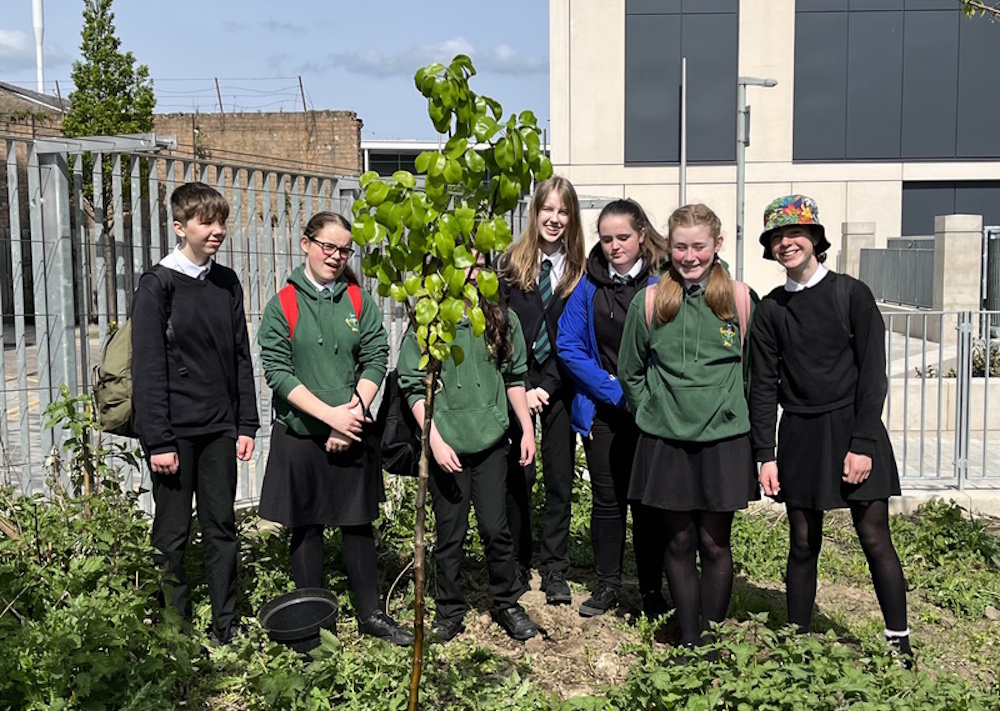
get our original raised beds back soon — the Pear tree that we were given as a reward for our eco probity really needs to be planted out.
Hopefully you will notice that the school is looking extra-super spruce on your return. There’s a reason for that: on Monday we have our Art and Design Showcase. I’ve been watching some of these works in progress, I can promise
you a treat. And to showcase the Showcase we’re going to make super-duper effort to make the school look nice. The refinery, the ceremonial gear, the rags and the rug, (refinery is the janny word for articles of this kind, its
etymology is lost), that we don’t bring out for riff-raff will be deployed. I suggest you pop in.
Now you may mark my work.
moments
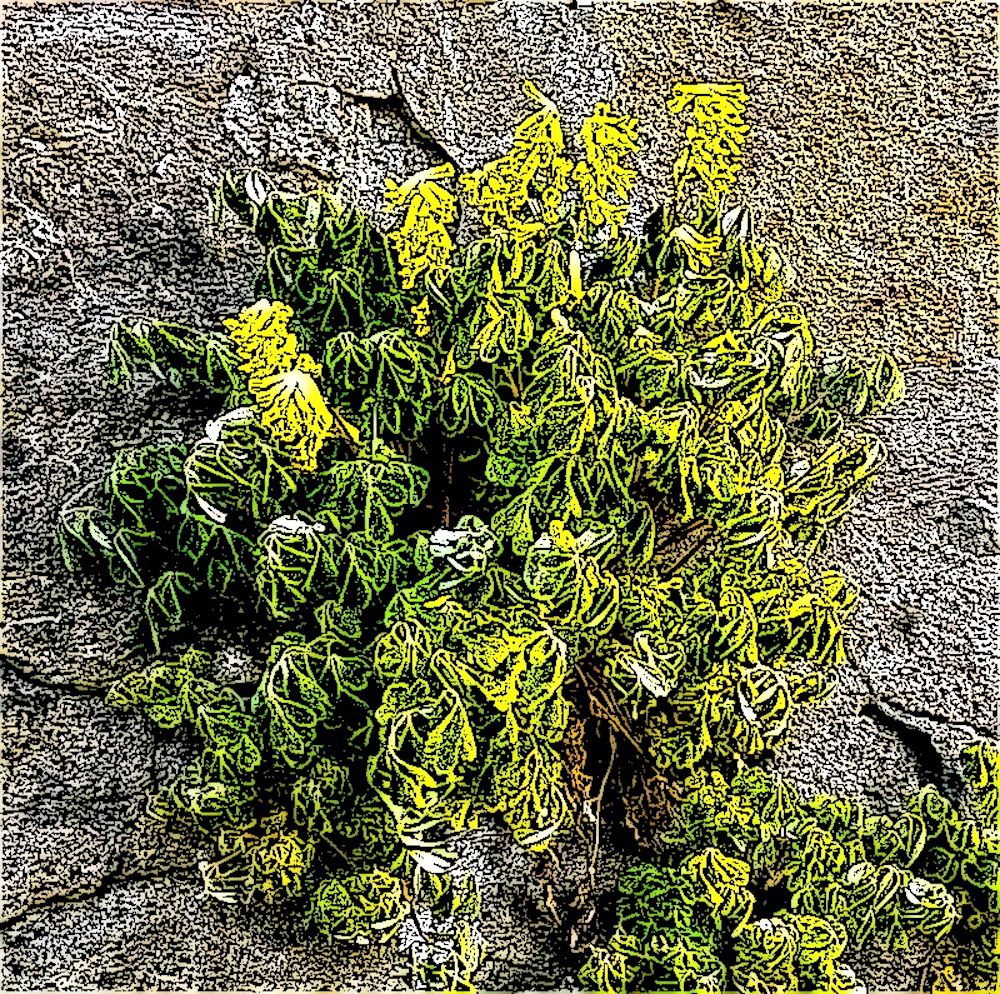
corydalis
This is the 17th century clothing part of spring — lacy, frothy, delicate; the colours bright, intense, but subtle. The period when buds burst, leaves unfurl and the world dons its dainty finery in preparation for the full Baroque extravagance of late spring. Twang! — that’s the sound of a metaphor, not particularly apt in the first place, being stretched beyond what’s reasonable and giving up . I can’t think of
an art movement less natural than the Baroque. Maybe Cubism? No mere art movement could capture nature just now anyway.
For me this is time of small moments, when I’m brought to a halt, often literally, by something new and fresh. Something that I didn’t see yesterday and won’t see tomorrow.
One afternoon I was walking home, wind and Sun in my face, the surface of the canal was choppy, waves rushing towards me, a myriad of sun-spawned diamonds scintillated across the waves. I stopped and watched these light-jewels wink and
dance, then the wind dropped and the waves and their lights were gone.
In a morning of mist I watched some Sparrows feeding in a tree in front of the school. These trees are filigrees of fluff and gauze just now. The Sparrows were skipping along the bouncing branches, heads swivelling and bobbing as they
snatched insects from the air. They’d reach the end of a branch, do a handstand, and drop to the branch below to start again.
One lemon dawn there were Seagull flocks in the park. There were at least a couple of hundred birds, they covered the grass, bouncing and squawking amiably. Blackbirds scampered about me and bird sound filled my head. Seagulls can be quite
aggressive with one another, here they looked almost friendly, as if they were hanging out. I was thinking about what they might be up to as strolled on, when I came upon a Corydalis,
in flower half way up a wall. I’d seen this plant before without noticing it, suddenly I couldn’t see anything else.
As I say, small moments, we’re not talking about watching Wagner’s Ring Cycle on the top of
Uluru at dawn. But any time stolen from the rote of our lives is time well stolen, our reward is a moment that you can’t really have
again, in the Heraclitus’ stepping in the same river sense anyway…
… Sorry distracted. The only musicians I can think of who would have the chutzpah to play Uluru are U2, possibly with Sting in tow and some poor saps that they’d rounded up at a pie stand in an Amazon logging camp and dressed
as Aboriginals. And the edge, what sort of person calls themselves the edge? makes a visual pun by hanging off the edge. Heraclitus would have my permission to weep at that. At least the world could unite in loathing.
Try to steal your own moments, just be careful.
creepers
honeysuckle
I’ve started to deal with the Buddleia in big-bed #3. I’ve been watching these thriving behind the workie’s railings, safe from me, for the last
couple of years. Now that they are back within my reach their lives are forfeit. Buddleias are pushy beggars and not a good fit for here. Their lives won’t
have been wasted, their timber will become part our urban woodpile, home to maggots, other dust eaters that creepeth on their bellies and Hedgehogs. Buddleias are hard to kill, I’ll be hacking away at ours for the rest of
the summer and they’ll still spring up again next year, refreshed.
This summer the playground should start to come together as a unit, if only because we’ll have it all to ourselves again. But the parts that will make the whole are coming along. Our nettle-fields (big-beds #1 & #2) are looking fine, to my eyes, and the wild flowers from Lucy’s bee-bombs seem to have taken in small-bed $1. Not cutting the lawn is already paying dividends — Starlings
have arrived from somewhere, Jackdaws have been poking about for nest-stuffs and there are Blackbirds in the mornings.
What’s growing in the planters on the sundeck is growing. I’m not sure what it is that’s growing but it is growing. Apart from some Yellow Rattle I decided not to
sow anything else — so what we’ll get is what has survived from last year. Which might be anything.
I broke one of my self-imposed rules and bought some Hostas for the sundeck. I’ve always liked Hostas but they are martyrs to Slugs. One evening you’ll have a Hosta, in the morning you will have a thing of lace sitting in a pond of Snail belly ointment. But there shouldn’t be any Slugs on the sundeck yet. They will creep their way there somehow,
but for now it should be fine.
There’s still one raised bed to get back (big-bed #4), this is where we, the young adults and I, will plant the Pear tree. I’ve never planted a tree. Luther didn’t actually suggest that we plant trees when the end was nigh but then he didn’t say a lot of the memorable things he’s accused of. It can be one of my bucket list things, along with swimming with Sharks, fitting Everest double-glazing and dancing with Spider Monkeys in their bosky sylvian glens.
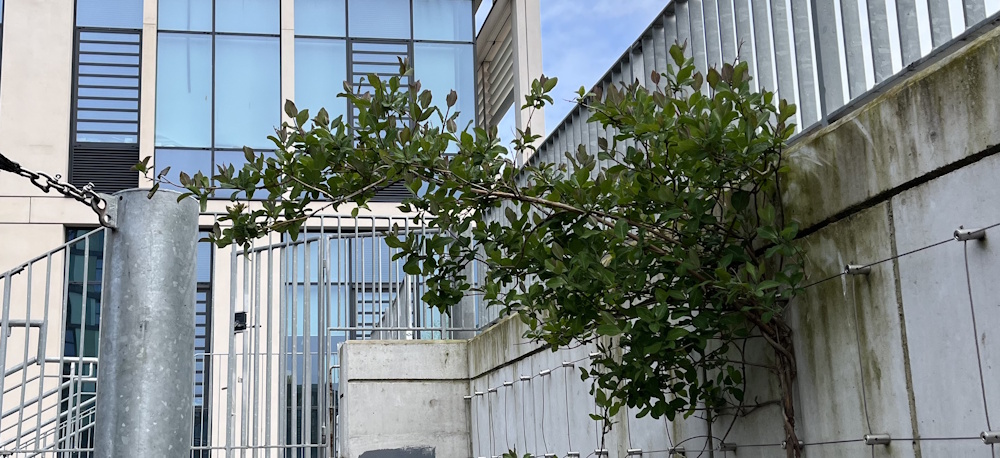
I was thinking all this rubbish as I walked back up the playground, the Honeysuckle in the picture above caught my eye. My first instinct was to laugh, so I did. It was just so right. Honeysuckle is good for wildlife and should look superb creeping across the sail. Will it fall on the young adults? Maybe in about a hundred years — I think we can risk it.
roads
dawn
Walking to and from work is a joy right now, the world is lush.
It’s difficult to use the word cornucopia without coming across as an arse, but I think that we must risk it. The world is a true horn of plenty, there’s always some bird, some plant, some stone, some sight, some person even, to draw your attention, so that you think — ‘look at that!’
The Butterfly of my focus flutters along these sights, stopping here and there to take in something special, which can be anything. A Goldfinch on a Birch tree, some new thing in the Rushes, the sudden glut of Honesty that has sprung up everywhere; or the walls along the towpath. Wonderful things these walls — a patchwork of brick and stone, riddled with plants, spackled with graffito, crumbling away, patched
together. They’re full of life:
Toadflax crawls across them, Valerian sprouts on tops, Spider webs fill
the cracks, fat Bees potter, oblivious to their danger; if you look closely there are Ants and Slaters, any mud is full of worms.
The canal was opened in 1822, the walls look as if they might have been built then. You wouldn’t build a wall for wildlife, but two hundred years of the right kind of neglect and care have allowed it in, human things will never
stand against nature and time. This thought gives me hope as a walk the sterile canyons being thrown up around here just now, streets that the seasons barely touch. In two hundred years people will walk these same streets, marvelling
at the quaint old housing, surrounded by the life that came.
The canal is still mostly a thing of the country, a ribbon of water running through fields. Like the railways and motorways that
took their jobs these canals are high roads for the wild. Where the human foot falls lightly, nature starts again.
I begin, or end, my walks at the lawn. I always spend a few seconds sitting here. It takes a few seconds, then nature resolves. You see the Dandelions growing through the fading Daffodils, the tussocks in the grass, soon you start
to see the insects. A flock of Starlings parachute from a Birch tree. They chatter, bounce and stab, half-hidden in the grass, their heads bob up at random, then with a burst of shrill peeping they sweep off. With them I go, on
my road, my shadow before me, in the dawn.
crime
Raskolnikov
Recondite and unrightful are the communications I receive from that nameless purpureal planet, sole satellite of Antares. For good reason is that sanguinary
star known as the heart of the Scorpion, what hails from neath the refulgent rays of that cinnabar Sun oft bears a baleful sting. These eldrich fiats and urgings, which somehow reach me from across the gulf of space, come
to me as dreams, or strange visions, as if I’d supped too deeply of Frosty Jack, that elixir
of the shaky seers. These outré intimations spur me on, to commit horticultural blasphemies, and indulge in vegetive perversities beyond those of mere human conception.
The nature of my interlocutor, its essential quiddity, the motives for its sendings, my selection as recipient, these questions are, and will remain I sense, unanswered. My mind recoils in horror if I probe too closely; I fear
to unlock the secrets that may be immured there. Or worse, to open some preternatural conduit across the interstellar abyss and unleash corporeal horror upon this world. I perceive it though, an exo-telluric, insectile
intelligence; I feel the rasp and click of trochanter on keratin scratching for release from inside my triune brain.
It has no powers of compulsion, yet. For now it plants only enticements in my mind. Its lures are subtle and crafty, whetting some inborn interest, honing it into unwholesome obsession, mesmerizing me with wild verdant
vistas, slyly suggesting reckless acts of Laurel larceny.
Thus I found myself, at five o’clock in the morning, under an overarching cerulean sky, digging up the Cherry Laurels inside the exiguous cyclopean fence of the new raised bed. A modern-day
resurrection man about his clandestine undertakings in the pallid azure dawn.
I mean what? I didn’t need to be furtive about this, and I wasn’t even that, I was on CCTV. And I forgot that the fob doesn’t work outside the goods entrance,
the door closed behind me, so I had to climb over the fencing. At least I didn’t fall. I can see the headlines — twat in his sixties breaks bones stealing his own plants. It’s not arthropods from
Antares that I need to worry about, it’s the contents of my skull, they’re on the fritz.
canal
pear — notice the school planting hat
I first became truly aware of the canal when I was living in St. Peter’s place, number nine, top floor, middle flat. I can see my old bedroom window from the front of the school. Where we are now was the McEwan’s brewery then,
wreathed in steam, hissing and howling and reeking of malt. The canal itself was covered in a poisonous-looking green scum,
which seemed to be the only life. It wasn’t a living place then. One year they pulled the body of a murdered girl out from under the Polworth bridge, late in the winter, after the ice had melted and her body had floated to the
top.
A few years later, when I worked at Craiglockhart,
I got to know a better canal, walking my dogs by Harrison Park. The canal was still blocked off at Wester Hailes then, when it got unstopped for the millennium you could see the change — nature seeping its way in. Then I returned
to Boroughmuir, so nearly every day since, I’ve walked to work along the canal. I’ve seen it change, season by season, year by year, growing, becoming wild and lovely. I’ve seen new plants, new birds, new animals,
all come to take this place for their homes. There are new people too, once only a trickle passed through, they have become a throng. By water, on foot or bike, with babies, dogs and grannies, people come to sit, to eat their lunch,
to meet a date, to canoe, to walk the dog, or just to walk home. The towpath has been paved, the canal gets dredged, the verges are tended, new houses have been built. It has become a vibrant, green, bustling, place. And now we are
here too. It’s time we played our part and made our mark.
We’ve made a mark just by being here of course; us and the building that is. I don’t know if you notice people noticing us; stopping dead and pointing, taking photographs, exclaiming, that’s a school! But by mark I mean something more personal, a statement of what we are, to show us to them. In the way that if you visited my house the decoration, the plants, the pictures on the wall, the things I own and how I
arrange them would say,
Neil’s like this. That will take time.
This isn’t a garden bought and brought, in a sense we’ve just let the towpath in. With the extension ours the first phase is complete. So planting the
Pear tree was special to me — a gesture to mark us getting the whole playground back, and the tree is the first thing that we, us and the young adults, have planted in our garden.
Unless we, or someone close by, plants another Pear tree we won’t get Pears, I’m not sure that matters, it might even be the point. What’s in the playground isn’t there for us in that way.
Ultimately what drives the canal is the clean bright water. That’s the route that nature uses to spread, to proliferate, to grow back to us. So that’s where we have to go next, water. So next week the Hub gardeners and I will make a start on the
first of the many ponds. Phase two begins…
melancholy
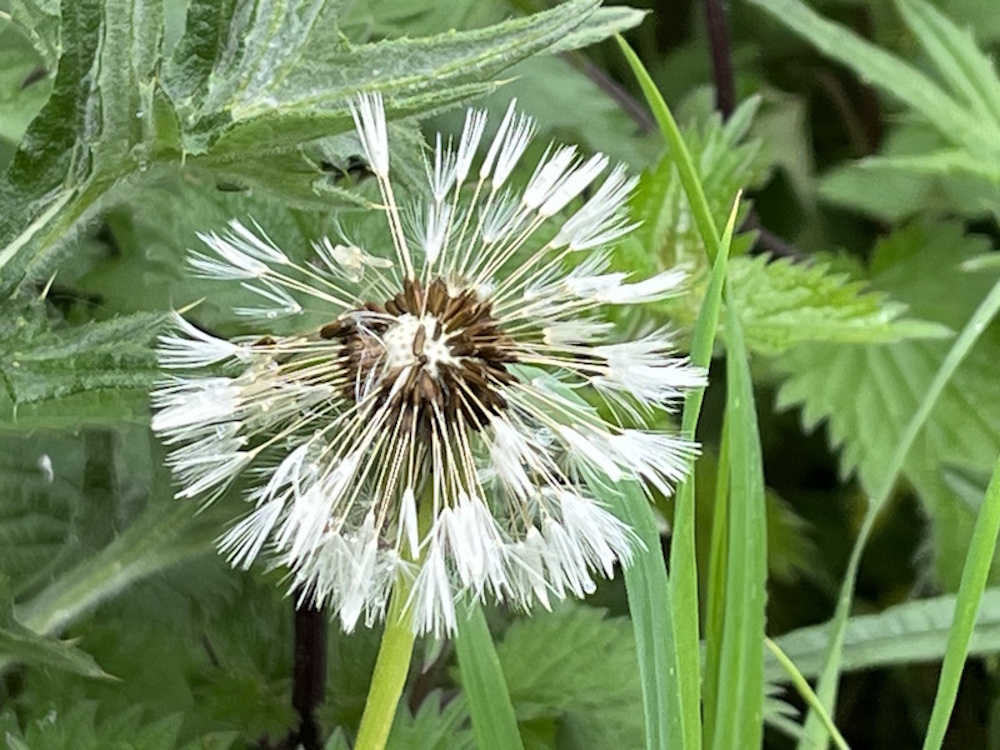
dandelion
I’ve been grumpy this week, which I’ve put down to being pestered by idiots. That’s unfair, I’m always caught up in the machinations of some numpty. Top grade numpties too, the elite of numpty-kind, numpties designer and artisan at the same time. Cyborg numpties, genetically modified, with prosthetic adaptations, all the better to snap right on to my tattie scones. I know that numpties are just a fruit of our original sin, a penance that all humans must thole, and I’m sure that I must star as a leading numpty in many another person’s theatre of wretchedness; it doesn’t help. Being irritated with people is just a symptom, there must be a root cause, my mood started on Monday, on my walk to work.
It was one of those mornings. A soft, wet, rain that seemed to hang in the air. The sky was low, white and thick. It wasn’t that early but there was no one about. I could walk slowly, I wasn’t rushing to work.
Everything was limp and still, slump-shouldered with dew. The big trees plopped off big drops, making ripples and bubbles on the black water. The birds’ songs were muffled, smells were strong. The scent from the bank of Hawthorns by the park seemed to clasp my face. A ripe cloying smell, instant hay fever. The dainty clusters of lustrous white flowers are so wondrous that the smell is worth putting up with. Now is a white time — with swathes of Wild Carrot, fluffy Dandelion globes, Elderflower pokes out, there are Horse Chestnut, Rowan and Hawthorn in bloom. Tucked up on a branch I saw a Coal Tit fledgling, a droukit Pierrot, spiky and strident. A wee jewel in a world so beautiful, but sad somehow. Triste is the word I think, an English word that remains stubbornly French.
Something of this mood snuck into me, I thought about Herodotus’s description of Xerxes, weeping as he sat on his big throne, reviewing his polyglot army before it trudged off across the bridge of boats to suffer a bad summer in Greece.
—— Look at all these people, not one of them will still be alive in a hundred years time.
And how right he was, the ringleted Achaemenid ham. Life is indeed evanescent, the beauty of my damp morning was vapor in the air come the Sun.
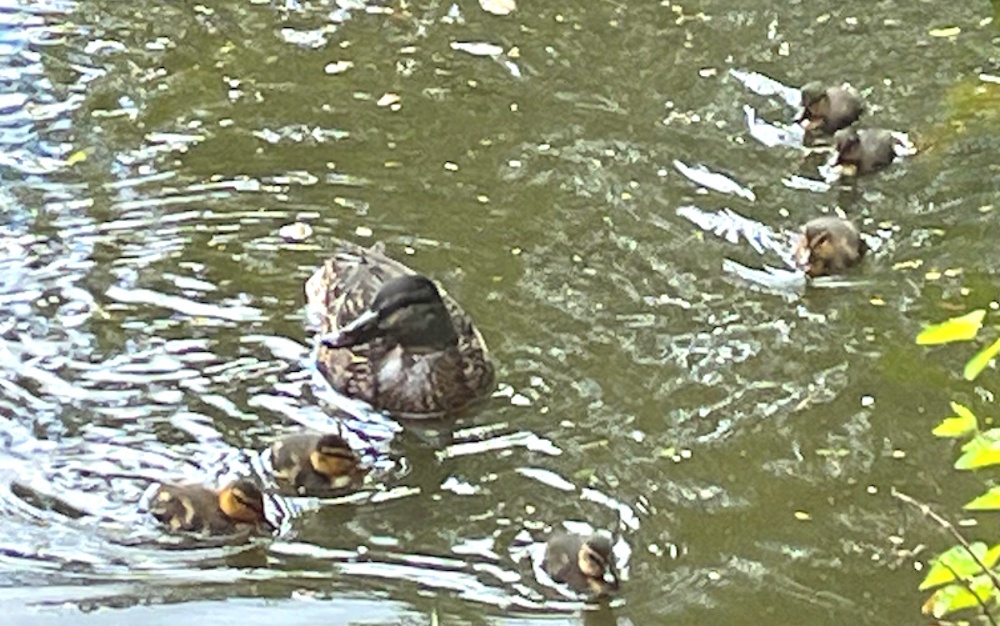
I grumped and stamped through the week, getting incandescent over trifles, full of black bile. I felt as if nothing mattered much. But if all things pass then grumpiness must go too. By Thursday I was happier. As I walked home I saw the young adults digging a pit trap in the meadow, there were swarms of Mayflies, fish fry pulsed in the brown water. Swifts, the sound of my summer, wall sailors, scissored the sky. (That’s what those fine poets the Germans call them – Mauersegler). There were new ducklings on the canal, who can feel sad when there are duckies in the world? Never did find out what made me grumpy.
ducklings
insects
comma
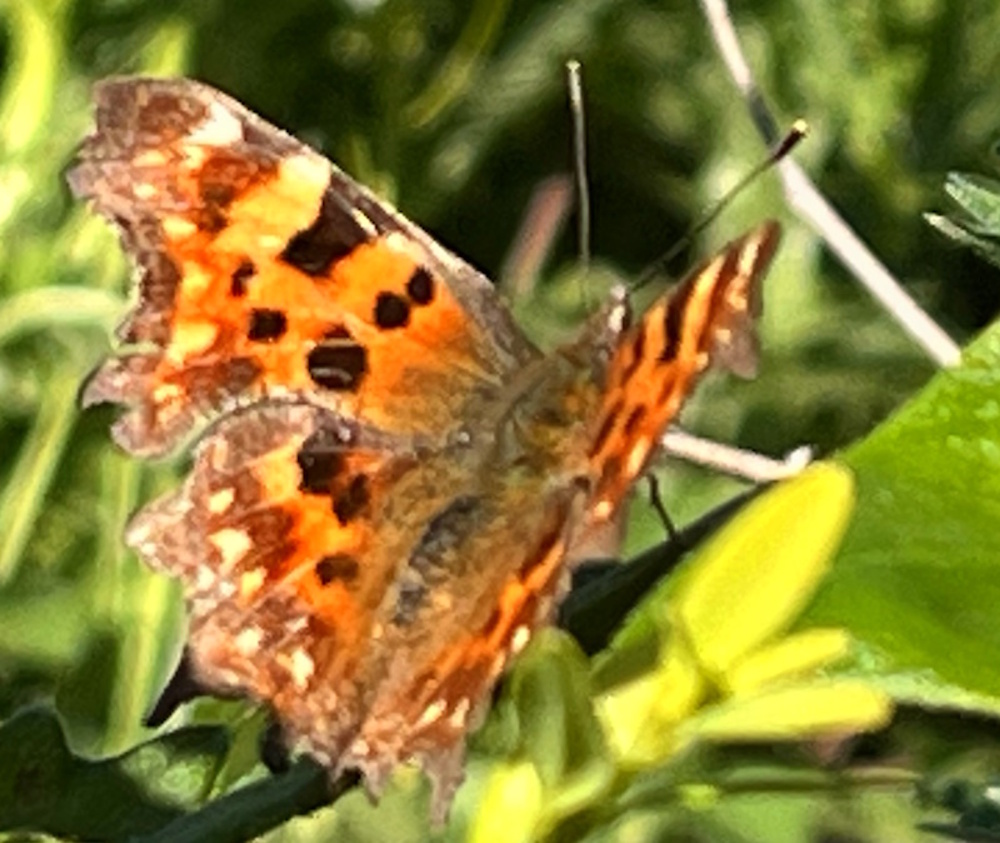
You may remember that last summer I decided to collect Butterflies, photographs of them anyway. You may have assumed that I’d given up on my quest, not so, I’m an incompetent, not a quitter. Above is a photo of a Comma, taken on the meadow. So that’s three I have now.
Butterflies (when they’ve stopped being caterpillars) are one of the diva species of the insect world, they’re the Squirrel on the Rat/Squirrel spectrum. They’re brightly coloured and flit prettily, hence they are nice; unlike Moths who are dull, skulk about at night and are clearly up to no good. You see the same irrational prejudice when it comes to Beetles — Ladybirds good, Dung Beetles horrid, which must be a cultural thing because the Egyptians had a Dung Beetle god, Khepri. Although being a god might not mean much. I might be projecting but I sense that when the Ennead invited other gods over for cocktails to a moan about the modern-day neglect of temples and the shocking cost of godding that there was a certain amount of sniggering at the god with the scarab head. Maybe not, perhaps a scarab-head was attractive and it was the bird-headed gods who were seen as Mr. Potato-head? How you’re judged depends on who’s doing the judging.
I feel a kindred spirit with insects, we’re probably in the same existential boat. We, humanity en masse that is, will look like insects to our alien overlords when they show up. Watch a speeded up street scene from a unfamiliar city and you’ll see why I think this. We’re obviously busy doing something, but what, and why? Are we intelligent? Do we have feelings? I think we can agree that it is important that we get across to our new rulers that we very much do have feelings. I’ve been watching insects quite lot this week, and I can’t say that I’m confident in our ability to do that.
If I asked you which was more intelligent a Butterfly or Termite, which would you pick? What about a Bee and Bluebottle? Tricky eh? And however clever you thought the bug was, would it stop you swatting it to death if it flew up your nose? No, intelligence isn’t going to be of much value when we’re sucking up to our bottom-headed lieges. We need something like a Squirrel’s bushy tail, something pretty to distinguish us from the scabby Rats, to be the Damsel Fly, not the Cockroach. There are people you can pay to massacre Rats and Cockroaches, we don’t want to become the target of stalk-eyed, star-spawned, pest controllers. We need to appeal to the aesthetic sense of something that has crossed the abyss of heaven, something that has twenty tentacles and no functional anus? Good luck with that. Who knows what aliens will find to their taste, maybe we’ll actually be tasty, a delicacy, extra-terrestrial Caviar. The Earth might become a stop on Gino d’Cthulhu’s gastronomic tour of the Orion Arm. And what happens if the space creatures are massively evolved Maggot things themselves? They’ll be mighty angry about how we treat their cousins. The outlook is gloomy for us I’m afraid.
Let’s hope that, while to their giant compound eye, we look a lot like the boggles that their swarm-fathers warned them about when they were larvae, that they realize that is just their prejudice. They aren’t allowed to stomp on us because we look horrible. We should be like that with insects. Besides, all insects are interesting if you look closely I’ve found. You’ll find plenty of insects, even Butterflies, to see in our raised beds.
evening
irises
As I locked the school the Blackbirds’ rippling complines percolated up from the bushes and the Swifts’ shrill serenade was far-away above me in a flat stonewashed sky. There wasn’t much wind but nothing was really still, here and there some zephyr brushed the rushes, spawned languid ripples in the thick brown water and stirred clouds of swirling flies. Buildings cast long blue shadows between smoldering pools of gold. Windows were open, leaking a cheerful clattering; of music, cooking pots and crockery, laughter, and people at their lives. A girl dandled her long tanned legs out of her window, shaving them as she shouted happily at some unseen someone within the dusk inside.
Wild Carrot still dominates the towpath, but the Elderflower is coming to its prime. There are patches of colour — shy Orchids in the rushes, unctuous Buttercups, solemn red Valerian, ultramarine Green Alkanet and, especially, Irises. These, tear-drops of some sun god, or perhaps the sparks from his chariot wheels, grow in clumps, which magnifies their impact. A vibrant clutch of yellow, standing proud and noble in the amber gloaming light. It might have been a reflection of my mood — I was tired, my legs hurt from moving furniture, but I felt that these were going over. I thought to see a softening, a feathering to their edges, signs that too soon they’d be gone. Different plants will hold court then; the Thistles are nearly flowering, the Willow Herb’s time is coming, the White Dead Nettles are on their way, various Vetches are threading their tiny ladders upwards through the undergrowth, nearly ready to flower.
It was Friday, the path was filled with courting couples, beautiful children, in their best attracting clothes, putting on their best selves for one another, happy and hopeful, brimming over with youth and joy. A snake of Scots-Bengalis wove past me carrying cricketing gear. The boys capered, squealed and squabbled, showing off for the girls who had that bland long-suffering look of women watching their partners playing the twat.
At the park, under the big trees, there was a barbecue. Children ran around it in screeching circles, tripping over yipping dogs. Their adults were clustered around the sacrifice, prodding the scorching flesh with long tools. The blue air smelt of meat and kerosine, a savour pleasing to JAWH perhaps, not so nice for me. Other people bunches dotted the park, sprawled like sacks of litter on the flaxen grass. Slugging beer and sipping wine, some inebriate edjits exposed a ghastly naked whiteness to the big red sun as it sank behind Corstorphine Hill.
I remembered another big red sun, sinking into the sea, as I left Morecambe on a train after a long dark winter. A memory since mythologized — wrapped with a bogus significance, to become a Janus moment, the terminus of my childhood, the start of my adult life. I was all of nineteen.
A pair of ancients (about my age) sat on a bench, white-haired, clad in pastels, their faces lifted sunwards, greedy for the light. Thrapples loose-hanging they looked like basking Turtles. I thought — that’ll be me soon, a tired old Lizard stapled to a rock. I felt a gut-pulse of timor mortis. It passed, I was nearly home and if the afternoon of my life is over, I still have some evenings in the sun.
I don’t know what people thought about the big red sun, sinking into the sea, as I left Morecambe bit, I suppose that I wrote it mostly for myself. I’d been on the train, going home to Edinburgh for easter, feeling, as teenagers do, all the woes of the world upon me. I’d just spent a bleak winter in Morecambe. There’s something ineffably sad about a seaside town in the off-season. Half full, the fun fairs closed, the beaches deserted, the sea and sky forever gray. And I was soon going to be thrown out of university; I’d done no work, there was no decision to be made about it, it just was. But when the train stopped and I saw that huge sun sinking into a flat charcoal sea I did feel as if I had made my mind up about something. So I’ve always remembered it as an inflexion point in my life.
The other sun I don’t remember. Well I can, because I’ve seen it often, but it’s just there as a symbol, a counterpoint to the Morecambe one. With mum and dad gone I’d been thinking a lot about the past, about who I’d been and who I’d become; about what I’d done with my life, about what I had left of it. This was unusual, I’ve always lived in the now — what’s been has gone, tomorrow can look after its self. But age and events had jumped up on me, for once I was thinking about my future, things had changed.