And Ham, the father of Canaan, saw the nakedness of his father
Genesis, Chapter 9, Verse 22
Dad was approaching ninety. He was still fit for his age, he could get about, go to the shops, visit what friends he had left, look after himself. He was fairly slow, but he’d always been that. He did have trouble eating — he’d had polio as a kid, he was in an iron-lung for six months. He’d recovered but the muscles in his throat were damaged, he always had problems getting his food down. This was getting progressively worse, he’d no longer eat in front of anyone. He was ashamed. He also had a withered buttock, which caused great hilarity in the family when this was found out —
——Didn’t you notice mum?
——They both looked much the same to me. They’ve both been pretty withered for a long time.
So he wore a lift in one of his shoes. His bum had slumped pretty far down his trousers by this stage, so we didn’t notice any change.
Mum had died just before the lockdown (remember that?). One of her cancers finally cutting her down. So dad spent his first years as a widower cooped up on his own in an empty house. Coco and I phoned him every day, and I played chess online with him every night, but it can’t have been easy. Not enough to do, too much time to think.
When we were all released he didn’t seem too different at first. Soon, however, we began to notice that he was having problems. He was having trouble with his words — he couldn’t find the right one, or used a wrong one. I called this asphasia, the doctors called it dysphasia, it was the same thing — two words that he probably couldn’t say, or would have got wrong. When he couldn’t find the word, he’d stop and stutter, and be angry with himself. When he used the wrong word there was often some sense to the replacement. He once described the opera he’d been watching as the one about the Spanish hairdresser. It, the dysphasia, wasn’t too bad at first, it was the odd word here or there, but it got worse. Soon it was the rare sentence that didn’t contain an error. The worst thing about it was his reaction; he knew what he wanted to say and it irked him when when he couldn’t find a word or when one came out wrong. Dad had always been such a placid man, to see him tetchy with himself was hard. He seemed like a different man. Coco and I reassured him that it was a normal age thing, and we reassured each other that his mind was fine, it was just the BIOS that was on the fritz.
There were other signs of decline. He developed obsessions — genealogy, creating a database of the plants in the garden, fussing with the central heating, doing jobs that didn’t need doing about the house. These were things he might have done anyway but he took them up madly then suddenly lost interest. The way he went about them had changed too. He’d always been a slow and steady worker, calm and measured, he wanted things exact. Now the way he did things wasn’t his. He was muddled, he wasn’t slapdash but he was impatient and there was a strange, new, stare behind his glasses.
He went down slowly, and because we saw him often, we were able to ignore, or minimize how bad things were getting. It was only when other people, people who hadn’t seen him for a while, saw him that we were faced with the truth. One such case was the visit, from America, of my aunty Joyce and uncle George.
After my parents aunty Joyce and uncle George were the most important people in Coco and my life; in the sense that they had been responsible for getting my mum and dad getting together. Aunty Joyce was my mum’s best friend, uncle George was my dad’s. So it was natural that when they got together they arranged a blind date for my mum and dad. A foursome, a dinner dance. I have a picture of this event stuck up on my fridge. Uncle George looking dapper, quite the man-about-town; aunty Joyce looking beautiful and elegant, almost regal; mum in what must be a new dress, skinny and pretty, perhaps a wee bit gauche. My dad is turning round from the table to look at the camera. He’s smiling, obviously happy, but nervous and unsure and so very young. From such a beginning Coco and I were born.
Aunty Joyce and uncle George didn’t say anything, they didn’t need to — I know them well enough to read their minds. I took them up to the school roof, I always take any visitors there. Standing next to aunty Joyce, looking out at the castle, I wondered what she was thinking. Mum dead and dad no longer himself. I couldn’t guess how that must feel for such old friends. Was she remembering that long ago meal?
——Mum died well aunty Joyce, you’d have been proud.
She didn’t say anything. Perhaps it was a stupid thing to have said?
Still, what were we to do? Dad could look after himself — the house was immaculate; he cooked, or reheated Marks & Sparks ready meals; he was clean and his trousers always had a perfect crease. Coco bought him twelve mixed bottles of wine at Lidl every month; he drank a very precisely measured two hundred and fifty millilitres glass with his meal every night and, if the weather was warm, a gin & tonic in the back garden beforehand. He didn’t drive any more, he wasn’t going to maim anyone, Coco and I had power of attorney, I’d made him a restricted account for his computer. We had one of those old-people-falling-over alarms installed and tried not to think too much about the future. Then four o’clock one Monday morning I got a call from the alarm people. Dad had fallen out of bed and was going to be taken to the hospital. By the time I arrived at the house he was in the ambulance. There wasn’t much I could help with so I went to work as usual.
point on the ecliptic
where the Coltsfeet are?
Now the festivals of mid-winter are over we are in those dull, driech, dolorous days that seem to stretch out forever before us until the spring arrives. The sorry litter of our solstice celebrations now moulders damply and nondescript
in the street, or it pokes out of the bins tatty and tawdry and dripping needles. January always seems such a desolate month; the joy has fled and we are left knee-deep in the sodden lees of our past excesses. It should have its own
paint range, Scottish Dingy™: every grey from drab, through nondescript and gaberdine to bleak. Suitable for your local school, penal institution or butt n’ ben.
During the holidays I did a bit of gardening, I had a plan: we have two beds of nettles, I would cut back one and leave the other … fallow? I was half way through this cutting back when I realized a couple of things, I was wet and
this was a lot like hard work. I stopped and watched the seagulls circling in a sky like a snapshot of an electrical discharge, bright and fiery but grim. I may finish the nettles off if the sun comes out, I may not.
The Solar, I must say, is coming along. This is the only real bit of gardening that we do and as we go on I’m getting increasingly ambitious for it. I was foolish enough to watch a YouTube thing about Sun Tunnels. I can’t help but notice that there’s a lots of tuby like things lying around in the building sites that have sprung up here-abouts that could be up-loved or whatever they call it. This place is crying out some sculpture. I mean we even have the classroom for 3–D art, don’t we?
If I’m right, and hey there must be a first time, in the next month or so we will get the Coltsfeet flowering, this can be taken as one of the first signs of spring. This is at the north end of the Solar where the statement bamboo will live. During the summer I noticed that there were a few Coltsfeet growing there, so I selectively weeded, hoping that come about now they would flower.
We shall see. If they do I’ll try to gather some seeds so that we can encourage spread. Coltsfeet have huge leaves that overshadow other plants, it would be a lovely piece of natural weed suppression. We could boast about it
to other schools.
In bird news I’ve spotted Graculus flying about with a young friend. I’ve seen him/her perched on the metal works a few times, as the young friend fishes below. Dare we hope for a nest and the pitter-patter of tiny flippers?
That would put the Swans in their place. And on that happy note let us return to yearning for the spring.
wet
art
Edinburgh seems to been subsumed into the hydrous province of The Archimandrite of the Brume, that hierophant of mists and murks, of spumes and torrents, who smudges every horizon and opens the sluices of the sky. In his realm the rain patters and pours from the great greyness above, where cars sizzle on wet-slick streets, streets and pavements glossy with water and quilted in a lacy fretwork of silver puddles, where rills slither over mats of mulched leaves and run gurgling and frothing into the sivvers. Here the bare trees, unless imprisoned upright in ivy, seem to melt into the ground, stark armatures slumping in search of something to support.
Jings, what prolix pap, prose so purple it’s bruised. I could have said something like city of the rain and left out the Eastern Orthodox ecclesiastical nonsense, and I must stop anthropomorphizing the weather, it’s becoming passé. I could, even, just have said wet. It’s been wet. There.
Despite the rain there are signs of spring. Some of our ducks have returned from wherever they have been. The males are getting chippy with one another and the females have attracted groups of admirers. Soon they will start flying around like the Dragonriders of Pern, the girls testing the boys in wild flights, the mating season is near at hand.
Not for our Shags methinks. I’m coming round to the idea that our pair are juveniles. From what I can gather if they were courting they would develop prominent quiffs. Not unlike the young of our own species who will fuss with their barnets in an attempt to lure potential partners into their ambits. Still this may be the beginning of a local colony, perhaps our young enterprise adults could sell their guano?
I understand that the carpark is being taken from you for landscaping, I feel your pain. Or rather I’ve been forced to listen to Scotty’s pain, which is arguably worse. So I’ll spare you the metaphor that I’ve
been polishing about you scrambling for spaces like gulls fighting over a soggy panini. Though I must admit that I’m looking forwards to getting our playground back again.
The workies building the extension were using what carparking we had on site to store their equipment. There was a great deal of moaning about this.
now, and next
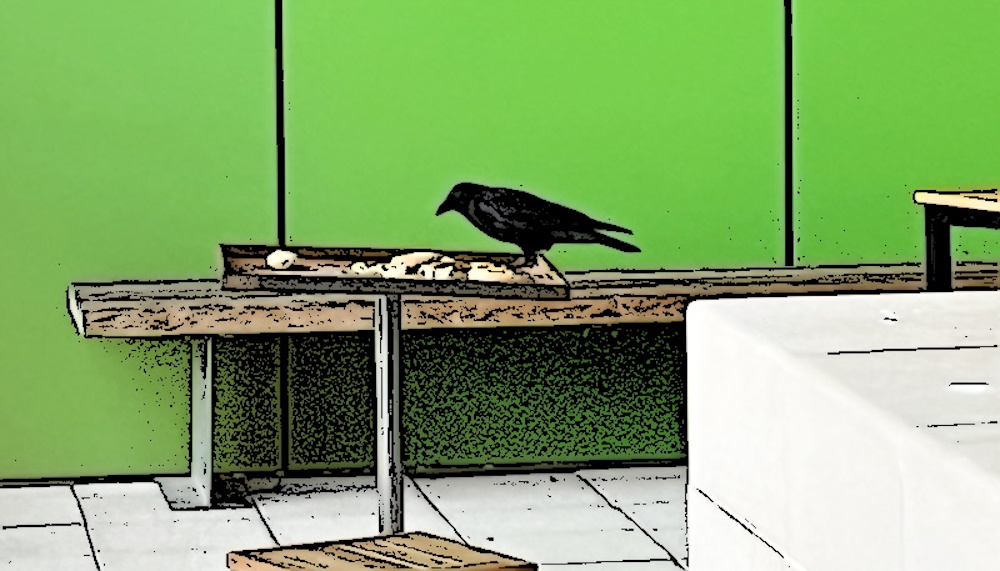
crow feasting
I’m caught in two minds — searching for any faint sign of spring but enjoying the beauty of these glorious brassy-bright days of frost. The light is so sharp, the colours so bright, the ice so fine and new and it makes such
a satisfying crunch as I walk. Even the chill that burns my face feels fresh and arousing. The trees, spreading their branches as if to warm their lichens in the sun, so jolly, so pretty, so of this moment, a morning poised in a brittle
crystalline now. A world precarious between forever and gone, like a faïence plate fresh out of the kiln, its colours sharp and partitioned, shimmering yet fragile. For there are shadows at noon and the evening falls early.
Still the twilights are gold and
Prussian Blue and clear nights bring out stars like droplets of Mercury spilt over the roof of the night. When I say stars there are a planets there too, quite a few at this moment. Living in a town we are robbed
of the night sky so we don’t really notice how changeable it can be. It’s really worth scouting out a patch of darkness in your local area to see such a night, you only get them in high-winter. It goes without saying that
it should be quiet, a few minutes should be spent gazing upward, mouth agape, drooling in awe.
Another thing I’ve been swithering about are the raised beds on the sundeck. I’ve started watering these for the year, I can’t decide whether to sow some new seeds, or to leave it to what seeded from last year. Last year,
I will admit, the planting lacked a little zing but is zing what we are going for? I ponder as I water. Watering is always a Zen thing, whatever you’ve been thinking about dissolves in a welter of nonsense:
——This one’s very bare and dry, will anything grow? Look at all those stones. That Buddleia will grow, must cut that back again. Is it growing now?
——Why are the seagulls circling? What are they after? There’s bread on the feeder, where did that come from? Do they see that?
——I should seed this one at least, remember how disappointing it was last year. But you didn’t start watering till late. Must fill another bucket.
——Splashed my shoes, idiot. Is that Balthazzar the Crow? [All crows are called Balthazzar for convenience.]
——Doesn’t the sky look nice, that river of bright against the blue and the fluorescents. And the bomb-smoke purple clouds and what colour is that? A carmine red? It was yellower a minute ago.
——Oh look somebody’s moving about in that flat. That must be soup they’re having, terrible decor.
——I won’t sow this one. The grasses are nice, but will they take over?
——Oh look there’s a star. Must be a planet, it doesn’t twinkle, it’s very bright and white, must be Venus. I wonder who the Roman equivalent of Venus is? Or is Venus the Roman one?
——No, maybe seed this one. Just a little, a splash of colour. Oh wait the trees, how are they doing? Still sticks? Nothing green showing, wait a few weeks.
——Is that some fungus growing under that bench? Surely not, ah cake wrapping, horrid stuff… God there’s more crap under here, where does it come from? Horrid children, give them a row.
——What’s that beeping? What alarm sounds like that? Oh it’s that truck moving that big something down there in the mud. I notice that there are lights on the top floors now. Where are they getting the electricity from? The mains isn’t connected, that big wire is still hanging there in the switch room. The heating pipes are lagged and ready, I wonder when they’ll plumb them in? February break I suppose. Won’t be long until their finished now.
——No leave at least this one unsown. Sow the bare one if anything. But what with? Poppys again? Bit bland, everybody does that. What would be good for wildlife?
——I hope there’s no thistles this year. You didn’t let them seed. What did Grampa say? One year’s seeding seven years weeding. That’ll be ten years then. No these seed things are always prime numbers.
Thirteen.
——One more bucket I think. Watch out you don’t soak yourself with that hose again. Jings.
In the end I’m undecided still. My heart says leave it unsown and it’ll probably happen that way, if only because I won’t make my mind up.
journeys
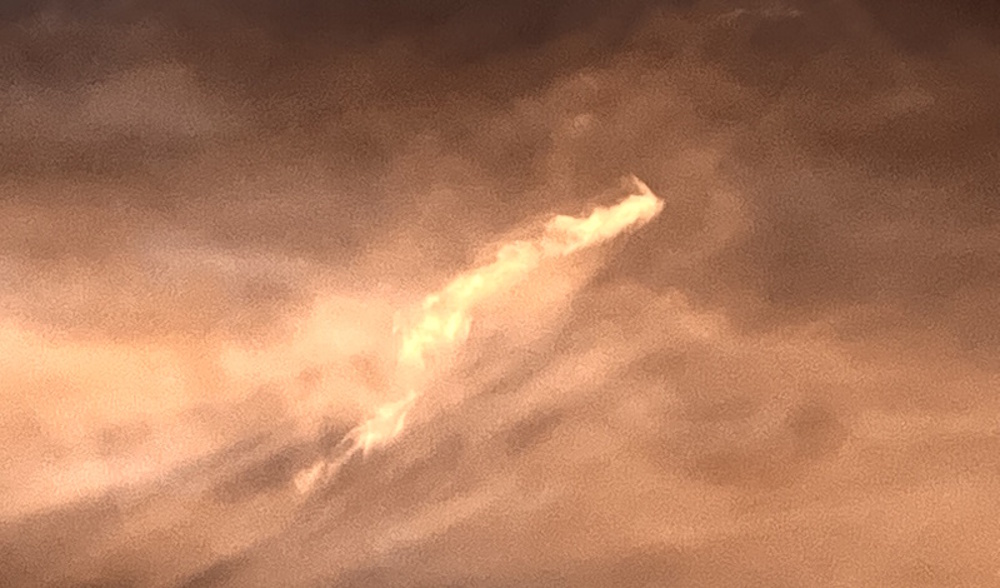
a cloud on the prowl
Over the weekend I got fascinated by water. Water in all its phases: the liquid, the solid and the vapour. And in all its places: in the air, on the ground, in the canal on top of other water, leaking from the drinking fountains. This
started on Friday night as I walked home. My Friday walk home often has a satisfying job done feel to it, the tasks for the week completed, the weekend about to begin. My mind often wanders.
There was ice along the canal, and what splendid ice. Ice of every type and hue. Scrunched and heaped up like broken biscuits in the pale golden light from the flats opposite the school, or chunked, all angles and facets or flat and crazed
and silver like fairy paving. The lights outside the flats opposite Gibson Terrace threw bright fingers of rumpled amber frost towards me as I walked by. After the Polworth bridge there were only a few pale lights from the tenements,
so the stars came out and the ice faded into a shimmer by my shoulder.
The next morning I got to reverse the process; walking to work just around dawn. It had clouded over and there was a band of bright white stretched behind the big houses on the south side of the canal. A rock on the water under the bridge
at Harrison Park uncoiled a long neck and became a Swan as I went by. One of last year’s signets, it had cleared itself an ice-free patch to sleep in. There was no wind and for noise only the far-off hum of traffic. A calm and
cold start to a day.
As I walked I thought about ice again, I sort of had to, it was everywhere. Ice must grow, little by little, crystal on crystal, then it seems to get shattered into lumps and shards, who knows how and who by. Then it re-freezes sharp again.
We wouldn’t say it was living but it grows and fades like something quick. Such strange stuff water, amongst other weirdness the solid floats on the liquid, the phase diagram is a joy for those who are odd in the same way as me.
Saturday is a very different day in the school, there’s a family atmosphere about Chinese School. Adults with children. It’s bustling and noisy, a village, where the most important thing is to see and be seen. All are dressed
to impress. Bright-clad little poppets run screaming between their oblivious parents, who chat, drink tea and eat tasty looking snacks. The teenagers posture at one another and try to avoid those embarrassing parents. Every hour or
so groups of tiny footballing girls charge boots-clacking from the
MUGA, their parents looking dowdy and tired.
It’s always pleasant to amble about watching the goings on. Outside the sky was red and wonderful. In general I’m not a great lover of clouds, they don’t provoke any raptures in me, I see no dragons chasing giraffes.
But on Saturday the clouds were a wonder. It looked as if someone had hired Van Gogh and told him to, jazz up the sky a bit. The cold was losing its grip, the ice was melting and there were patches of water reflecting the sky.
All three phases of water around me at once all red and blue. Technically the stuff in the sky wasn’t water gas [steam], it’s more like a Colloid, more
satisfyingly odd stuff.
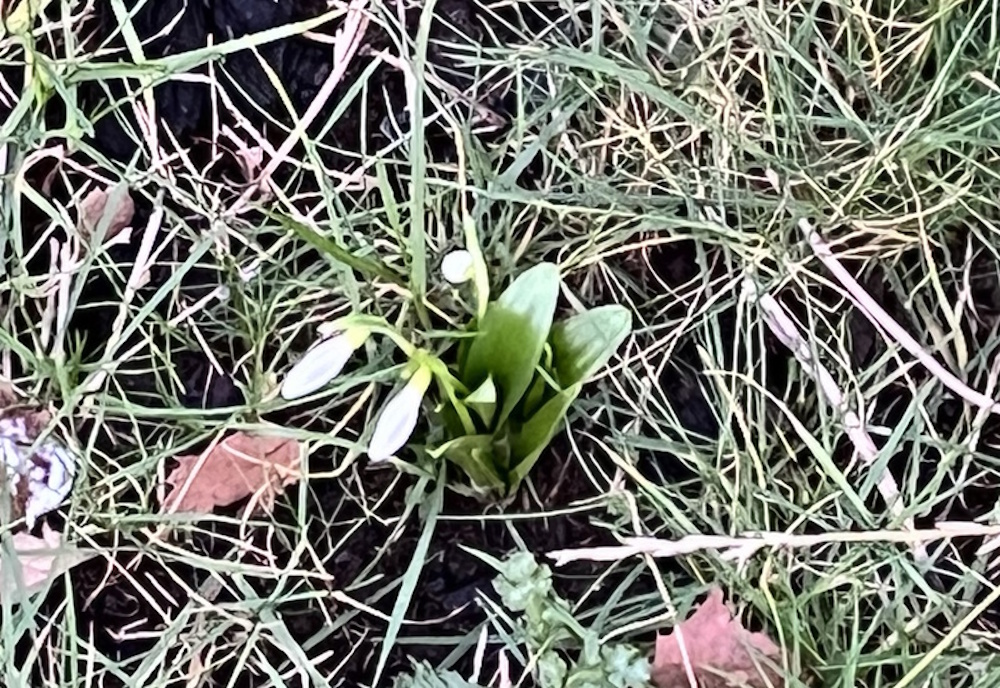
Then I saw it. The first crack in the edifice of winter …
snowdrops
kingfisher days
pigeons at home
These are halcyon days. If you look up the etymology of halcyon you might be in for a surprise, it’s derived from kingfisher and originally meant the windless days around the solstice when Kingfishers nested on the calm open seas.
The kind of days we are having now. There’s a tale attached, it concerns Alkyone, the daughter of the god of the wind and her husband Ceyx who were offed for dissing Zeus and Hera. Well, he was offed, drowned in a god arranged shipwreck, she, gutted, threw herself into the sea, which moved the gods to turn them into Kingfishers and her father calmed the winds around christmas
so that they could breed. Did the Greeks believe this tosh? About Kingfishers nesting on open water that is. I doubt it but…
The Greeks were a very rational people [you might think that they would have invented the word but it comes from the Old French], they thought their way through how things worked, they didn’t observe them. Then again it
might only seem that way because what we have left of their thoughts is what was written by the aristos. Aristotle may be the equivalent of An Explanation for Everything by Bertram Wooster for all we know. But I think that the
problem is more one of how people observe the nature that is around them.
At the end of The Green Hills of Africa where Hemingway and the rest of the gruesome crew drink and watch Grebes in the Holy Land someone asks why Grebes
aren’t mentioned in the Bible. Hemingway, who was probably drunk, says that this was because The Jews weren’t naturalists. What the tosser means is that only people who murder animals for fun and profit really observe nature.
Socrates would have derived much pleasure from putting Hemingway in his place. Again though, the problem is in our relationship to the nature around us and how this affects how we see it. Everyone knows there are Grebes everywhere,
why bother mentioning them? Pigeons are like that.
In my experience batty old women come in two main flavours: those owned by cats and those who feed pigeons. I understand the second type better. Pigeons get a bad rep, they’re called flying rats, another maligned creature, and a
generally sworn at if they aren’t being ignored. Why? I suspect one big reason is that they are common; both in the sense that there are a lot of them around and because they clearly belong to the avian proletariat, slum birds.
Very unfair, pigeons are very special. If they were big and white and had attractive babies?
Pigeons are marvelous flyers and fast ones, they’ve been clocked at over ninety miles an hour. They are fine acrobats too, plunging, jerking and twisting, looping through the bridges. A flock taking off in the sunlight is a thing
of great joy. They’re intelligent, they recognize themselves in the mirror (how is this known?), and they’re very social creatures, they play well with each other. Their navigation skills made them our go-to long-range
messengers before we invented radio. There’s a subsection of batty old men who still race them because of this skill. And of course we can eat them.
Our local ones nest under the Polworth bridge, protected by the spikes that have been put there to stop them nesting. Touch of the Greek problem there — you see these spikes everywhere, why, when these are clearly pigeon friendly,
do we keep putting them up?
I suppose what I’m saying is enjoy these halcyon days and please take some time to watch our marvelous pigeons.
sap
some buds
I love this time of the year, with the buds swelling on every branch. Winter grips us still but in the right light and from the right angle you can glimpse spring starting to shade the world. Faint colours glimmer insubstantially around
the edges of the trees. Pastel colours, and a mere haze but there.
Things change fast just now, for the world of plants that is. Last week there seemed to be no buds; this week they’re on nearly every tree. Although some trees, like Tolstoy’s Oak, are biding their time, most are showing some signs of life. That's another nice thing, that different trees produce buds at different rates. And there are so many kinds
of bud. Some fat, juicy and ready to burst, others smaller and more delicate, yet others just fine tendrils of green.
Our Honeysuckles are already sprouting their first leaves, a drab green and purple but healthy and welcome. The Vincas in the proto-hedgerow by
the pre-wildflower meadow even have the cheek to be flowering. Vincas are just plain odd.
So the sap is rising. From whence springs this substance sap? Where does it rise from? Does it pool underground? Are there vast subterranean lakes of the stuff? That would be wonderful wouldn’t it? Like Bism in the Silver Chair, with its own history and ecology. A whole other world beneath our feet…
At this time of year the whimsy rises in me it seems.
Now you’re off on holiday where you are ordered to take care of yourselves. I have a gardening plan which no doubt you’ll hear about. When you return the Daffodils will be ablaze.
finally home
It’s funny, I thought that dad was in hospital for about a week. It must have been longer because I remember writing some parts of the above in my head on the bus going to the hospital. I spent a lot of time on that bus. There are some bits there which summon sharp pictures to the eye of my mind; I can still see exactly some of the scenes that I was trying to describe. Or I think I can. Memory is a tricky thing — it can lose bits of time and clutch-up an instant.
After work on the day of dad’s fall I took my first bus to the hospital. Dad was still in A & E, but he was going to be admitted. There was talk of a week. Dad was conscious, a wee bit weak but seemed fairly fine. He apologized for being such a, ruddy pest. I took this as a good sign, it was typically him. Coco and Ana were in Spain, we agreed that there was no point in telling them what had happened. He’d be home by the time got back and we didn’t want to spoil their holiday with worries. I left to take another bus when he was taken off to the ward.
Later that week there was a meeting with a doctor. Dad had had a very nasty infection, caused by some food going down the wrong tube and ending up in his lung. The polio was still trying to kill him. He’d recovered well, but she wanted him to sign a do not resuscitate order. I was agreeing that this was a good idea for the future when dad tapped my arm, I want that. So it was signed; and written up under dysphasia with the other stuff on the whiteboard behind his bed. At the time this didn’t register with me, after all dad was going to come home. It was only later that I realized that a bridge had been crossed.
Hospitals are strangely reluctant to release the aged once they’ve got their claws into them. They never seem to feel that the patient has recovered enough, and they become very nosey about the available care and accommodation they are to be released into. So by the time they were ready to let dad go home Coco and Ana were back. Fortunately, for me, Coco and Ana had worked in the NHS and could, and did, deal with these problems. I took a week off work to help dad settle back in at home; Coco and Ana were retired so they could be there whenever. We assumed that when dad got home he’d need a wee bit cossetting while he settled back in, but then things would go back to normal. Or as normal as they had been.
The first sign that this wasn’t going to be came the night dad got home. We’d prepared some of his favourite foods, which he couldn’t eat; and a glass of nice wine which he couldn’t drink. When dad went to his bed and we had a discussion. We were still in denial. We talked about long-term care. I think we knew that wasn’t going to be needed, we just didn’t want to admit it quite yet. Certainly not aloud, not to each other. We agreed a wait-and-see plan. The settling back in period was extended, so I arranged for an extra couple of weeks holiday. That turned out to be more than enough.
lawn
the lawn wildflower meadow this weeklast summer — result of a cutlast summer — no cuttingsame but sunny
As a child I played a shambles of a garden. It was a wilderness of stone, concrete, bare earth, weeds and feral trees, trees that would have your arm off if you got too close. There was a tumbledown shed, some broken cold-frames, a precipitous
slag heap in a dark corner and three long, white greenhouses. But best of all it had a potting shed. This was up against the street and had a thick dark-green glass window out of which you could watch unseen. I spent many a happy hour
there, crouched amid the stacks of broken pots and packets of poisons. Nothing happened on the street, but it was nice sitting in the dark, smelling the creosote and damp earth, playing with garden twine and listening to the rain pattering
on the roof.
My Granpa had been a gardener, he’d once grown plants in my garden to make his living. But by the time I was born he’d retired and moved out, so nobody looked after it, entropy and nature were working their charms. It was my
fantasy kingdom, that grew lovelier as the things of man tumbled and the weeds waxed rank. Then Mum and Dad sold half the garden and the money drove them mad. They tore everything down, sowed a new lawn; paved new paths; planted housebroken
trees and filled new borders with new shrubs. I was ten years old, lawns were a big part of my first experience of the patriarchal
capitalist plot to suck the marrow of joy from this world and despoil any beauty. I’ve
hated lawns since then.
Thus it was with some pleasure that I emailed our parks department this week to ask that they didn’t cut our lawn this year. The idea came from the young adults of our ECO group and it’s a good one. I’m not sure what
they think the result will be, wildflower meadows were in the air. That won’t happen. However, it’s been agreed not to cut any grass and the parks department are going to arrange a visit to talk with the ECO group.
We do have some experience of what happens if you don’t mow the lawn. Last year they did the first cut late, at the end of May. That was too soon, I remember the Starlings being busy in the different grasses that had grown up. There
must have been lots there for them to eat. When it got cut they left. We’ll get more variety in our grasses and a few flowers. It will be better for nature and interesting to watch. But best of all it won’t be a proper
lawn any more.
house
view from a window
My wee brother Coco and I have been staying with my dad in Morningside this week. Morningside is now a long yellow-grey trench of emporia infested with pensioners. Here you may buy all things chic and bijou — Venezulan Beaver cheese, bat guano body scrub, Le Creuset
pans, fine art, Puglian sausages, a wee cottage in Banff, or the coffee of seven continents with a cake of many hues. When I grew up here it was somewhat different.
Then it still had a working smithy. My uncle Bill, probably no relation, who had survived Gallipoli, he said, on rum and MacKechnies pies despite being a notorious teetotaller, had his monumental masons shop. Grampa still sold the plants grown in our garden; the milkman had his horse for his cart; I got sawdust for the rabbits from the cabinet maker’s shop by the library; fishwives in aprons came from Newhaven weekly; the onion johnny, in stripped shirt and beret came yearly from France. Village stuff. True, it was still Morningside — the quality of our street
sent their servants round with presents to celebrate Coco’s birth. We were not quality, we didn’t dress for dinner and bathed once a week.
The gardens in the street are now all landscaped, groomed and mature. They have decking, marble tables and hand-crafted chairs. No more scrubby lawns, half mud, where we played football and tig. There we held our street olympics, test
matches, Wimbledons and world cups. The raddled old fruit trees, that every back garden had, with their sour, hard crop, so lip-puckeringly wersh as to be almost not worth stealing, have been replaced with Viburnams, stately evergreens
and Magnolias. Neville’s pigeon loft is what looks like a sauna. The lane that runs behind the houses is still much the same, rutted and weedy with a strip of grass up the middle. The old barn that must have been built for next-door’s
horse and carriage, against which we played crossy, has a basketball hoop. The old Elder tree in the crook of the wall where we perched like little Vultures on summer mornings to plan the long sunny days is now long gone.
Not all has gone, nature is still rampant. Squirrels undulate along the grey walls to an orchestra of birds: trills and peeps, chirps and tweets, the piercings of gulls, with a soft static of Starling for a background. It’s spring,
territories are being declared, partner wanted ads sung. Crows and Gulls sweep long and high in the leaden skies, a pair of swans flew over in the distance. Closer, other birds flit from tree to tree; in flocks, pairs or lonely.
Fat Wood Pigeons and Magpies dot the bare branches. The bird feeder in our Magnolia attracts a constant custom — finches and tits, a solitary Robin. Blackbirds scrabble and peck underneath. At night, having a fag by the backdoor, I saw slugs, long, black and glossy, heading somewhere. In the garden things rustled, far off some nightbird screamed.
One day I walked up the lane, feeling strangely a stranger. The block of council houses where Glen lived is now all boarded up. Snowdrops are growing on the drying green. There’s a car park in the hossy (hospital) field, where we
had our gang huts, dad’s gang hut had been a treehouse, he was gifted with wood. But it’s still mostly just weeds, leaf litter and rotting wood. Good for nature. A pair of Magpies were tossing leaves and beech nut husks about under
a tree. I climbed onto the wall and saw that someone has a swing. I wonder if Owls still hunt here, bringing silence in the twighlight, descendants of the Owls we saw as we played on our swing in the last rays of those days?
Great grampa moved his family here in nineteen-o-eight, from somewhere in Perthshire, there were still patriarchs then. Since then we’ve lived here, been born here, and died here. We’ve moved out and back in. Grampa to America,
to work on the railroad, returning for Flanders and finally home. Grampa John, mum’s dad, died in the front room while Coco and I played football with rolled up socks in the hall. Mum died in the other front room, watching the birds at the
feeder. It’s a house where life is lived and goes on. Now the dad has gone, from the same room as mum, we’ll sell the house; it needs to be filled with a family and children again. They won’t have my kind of a childhood but still
a good one I think.
For Coco’s sixtieth we’ll have one final barbeque, build a fire in the pit with the last of dad’s wood to throw sparks at the stars. We’ll drink up dad’s wine. A libation, not to fierce Dionysus or fat Silenus with his stupid horse ears but to the Lares and Brownies, the small gods of the house, who have been so very kind to us here.
deathwatch
I wrote most of the above as Dad lay dying. Which took about a week and felt like a couple of months. The clock in my head again running wrong. Dad let go slowly, but every day worse. He’d stopped eating and drinking, but he still went to the toilet. The graduations of his decline were marked by this pissing — at first he managed to stagger to the toilet using his zimmer, then it was the commode, finally the catheter was fitted and he kept to his bed.
He spent most of his time sleeping, waking every so often to stare at his watch. He knew he was dying, was he worried about being late for something? One night, when I was sitting with him, he had a bad dream. He woke up distressed. I hugged him, something that I’d never done before. I couldn’t think what else to do.
——It’s OK dad, it’s just a bad dream, we’re here. This seemed to settle him, he went back off to sleep. I sat in the semi-darkness, watching my dad’s clapped-out old body, thinking about the vital young man who’d once hugged my bad dreams away.
When you read about people dying at home in bed it sounds somehow enchanting, a fitting finale to a wonderful life. They died peacefully surrounded by their family. You imagine the dearly nearly-departed propped up in bed, the family crowded round, lapping up any final words. My experience has been very different — the patient unconscious for days, me sat there guiltily hoping that the reaper would get his skates on. Being us we missed his visit.
We’d taken to watching a boxed set of I Claudius after our dinner, before the night watches. We were relaxed, Coco and Ana were having a glass of wine. We were all laughing at some piece of Jewish stereotyping that, one hopes, wouldn’t be broadcast today.
——I just go and check on him. I said.
Dad was dead. The pupil of his left eye seemed to have burst, filling the iris, squid ink black, perfectly square.